A couple of emails I've received in the past few days have been so upsetting that I will be suspending this blog for the time being.
I don't recognize this country anymore.
The first email I got was about the descent of America into fascism under this president. The 14 Characteristics of Fascism outlined by Lawrence Britt in 2003 is illustrated in a short video, but here this is his breakdown:Powerful and Continuing Nationalism
Fascist regimes tend to make constant use of patriotic mottos, slogans, symbols, songs, and other paraphernalia. Flags are seen everywhere, as are flag symbols on clothing and in public displays.
Disdain for the Recognition of Human Rights
Because of fear of enemies and the need for security, the people in fascist regimes are persuaded that human rights can be ignored in certain cases because of "need." The people tend to look the other way or even approve of torture, summary executions, assassinations, long incarcerations of prisoners, etc.
Identification of Enemies/Scapegoats as a Unifying Cause
The people are rallied into a unifying patriotic frenzy over the need to eliminate a perceived common threat or foe: racial , ethnic or religious minorities; liberals; communists; socialists, terrorists, etc.
Supremacy of the Military Even when there are widespread domestic problems, the military is given a disproportionate amount of government funding, and the domestic agenda is neglected. Soldiers and military service are glamorized.
Rampant Sexism The governments of fascist nations tend to be almost exclusively male-dominated. Under fascist regimes, traditional gender roles are made more rigid. Opposition to abortion is high, as is homophobia and anti-gay legislation and national policy.
Controlled Mass Media Sometimes to media is directly controlled by the government, but in other cases, the media is indirectly controlled by government regulation, or sympathetic media spokespeople and executives. Censorship, especially in war time, is very common.
Obsession with National Security
Fear is used as a motivational tool by the government over the masses.
Religion and Government are Intertwined
Governments in fascist nations tend to use the most common religion in the nation as a tool to manipulate public opinion. Religious rhetoric and terminology is common from government leaders, even when the major tenets of the religion are diametrically opposed to the government's policies or actions.
Corporate Power is Protected
The industrial and business aristocracy of a fascist nation often are the ones who put the government leaders into power, creating a mutually beneficial business/government relationship and power elite.
Labor Power is Suppressed
Because the organizing power of labor is the only real threat to a fascist government, labor unions are either eliminated entirely, or are severely suppressed .
Disdain for Intellectuals and the Arts
Fascist nations tend to promote and tolerate open hostility to higher education, and academia. It is not uncommon for professors and other academics to be censored or even arrested. Free expression in the arts is openly attacked, and governments often refuse to fund the arts.
Obsession with Crime and Punishment
Under fascist regimes, the police are given almost limitless power to enforce laws. The people are often willing to overlook police abuses and even forego civil liberties in the name of patriotism. There is often a national police force with virtually unlimited power in fascist nations.
Rampant Cronyism and Corruption
Fascist regimes almost always are governed by groups of friends and associates who appoint each other to government positions and use governmental power and authority to protect their friends from accountability. It is not uncommon in fascist regimes for national resources and even treasures to be appropriated or even outright stolen by government leaders.
Fraudulent Elections
Sometimes elections in fascist nations are a complete sham. Other times elections are manipulated by smear campaigns against or even assassination of opposition candidates, use of legislation to control voting numbers or political district boundaries, and manipulation of the media. Fascist nations also typically use their judiciaries to manipulate or control elections.
Copyright © 2003 Free Inquiry magazine
The second email alerted me to Winter Soldier: Iraq and Afghanistan, an event sponsored by the Iraq Veterans against the War. It consists of testimony from vets and civilians about what's going on over there under our name. You can see bits of live testimony on their website and read some of the testimony in The Progressive and elsewhere. It's as chilling as it is humbling.
The last email I got was about a new twist in the presidential campaign, and this I knew nothing about. CNN apparently mounted a Faith Forum this past Wednesday, where the candidates could elaborate their positions on religion. I heard on an Air American broadcast this afternoon that atheists, agnostics and seculars of all kinds were not permitted entry. So, not only is religion being used to vet candidates for a secular office in a country whose citizens are protected by the First Amendment, people who are not religious were barred from the event altogether. This article by Michael Hess outlines the essentials:CNN's "Faith Forum" an Outright Religious Test for Public Office
Wednesday, April 16 2008
Religious freedom organization objects to using religious faith as a litmus test for politicians seeking election
Nearly a year ago, when CNN broadcast a presidential faith forum last June, the Freedom From Religion Foundation issued a statement condemning the imposition of a religious test for public office.
CNN has jettisoned any pretense of objectivity and professionalism by continuing to make candidates genuflect before religious leaders, parrot piety, and pledge allegiance to religion.
The founders of our nation felt so strongly that there should be no religious test for public office that they prohibited it (see U.S. Constitution, Art. VI). That constitutional bar is meaningless in today's political climate, if politicians, in order to be electable, must not only sing in the choir, but sing from the same hymnbook. When did "faith" become a qualification, much less a prerequisite, for public office?
Sunday's so-called CNN Faith and Politicis Compassion Forum, bizarrely taking place at the obscure Messiah College in Grantham, Penn., involved such questions from CNN's hosts as:
"You have actually felt the presence of the Holy Spirit on many occasions. Share some of those occasions with us."
"Do you have a favorite bible story?"
"So you believe God wants you to be president?"
"Do you believe that God intervenes in hisory and rewards or punishes people or nations in real time for their behavior?"
"Senator, if one of your daughters asked you--and maybe they already have--'Daddy, did God really create the world in six days?' What would you say?"
"Can you tell us how he [your pastor] helped bring you closer to God?"
This is a journalistic embarrassment, not bona fide campaign questions. CNN and hosts Campbell Brown and Jon Meacham of Newsweek should be ashamed. The event had no secular representative, but boasted as audience questioners a Catholic, a rabbi, the head of the Southern Baptists, a Muslim. Only one question (from the Muslim) mentioned nonbelievers in passing. Not all the questions were on religious topics (thankfully). But the ugly assumption of the compassion forum was that religion has a monopoly on virtue, and that nonreligious people cannot be part of a debate on compassion. CNN ought to show some compassion . . . to its thinking audience!
While the GOP candidate, who has freely courted the religious right, felt free to skip this forum, the Democratic contenders have been so brainwashed that they fear above all being labeled irreligious if they boycott such "events." What a dismaying development. It's a no-win situation for the candidates, for (bored) viewers, and above all, for the Constitution.
Who needs a religious-right lobby when we have the media taking over the religious agenda?
It is no less true now than it was 5 years ago that the BoE of this great city is being run by an arrogant and venal chancellor. What he does no longer surprises me, because every decision he's made has been unsound and inexplicable. It will take a decade or more to undo the destruction — shades of Naomi Klein and her shock doctrine.
Weingarten and Co. have disappointed and will no doubt continue to disappoint. Fortunately, there are plenty of other ed activists who will keep deconstructing her statements and strategies, and these people are very good at what they do.
There's a lot of work to do in America, and it's time to roll up my sleeves.
 It was a quick response our girl made this afternoon, when a member posed a question about all that paper at the Delegate Assembly that just gets thrown away and really needs to be recycled. Couldn’t bins be provided to collect it in?
“That’s a wonderful idea,” said Weingarten, or words to that effect. “I wish I had thought of it myself.”
Wait a minute, hold on. The papers that were giving the delegate so much grief in their un-recycled state were the handouts quite a few people go to a lot of trouble to print up. I’m not just speaking about the literature produced by ICE, TJC and the other opposition caucuses. There’s a whole range of stuff out in the lobby that people should be reading: revised agendas, minutes of the last DA, notices of union events, copies of newspaper clippings, articles, Unity materials, and other kinds of documentation.
The delegates coming down to 52 Broadway once a month should be collecting whatever’s being distributed before the meeting and bringing it back to their schools. They should be posting it on UFT bulletin boards or in teacher cafeterias. That’s part of their job. The last thing one would expect is that a delegate to this assembly reads a handout, considers it garbage, and throws it away on the spot.
And the last thing one would expect from the president of the union is to say: Yes, throw it away before you leave the building. Great idea. I wish I had thought of it.
The correct answer should have been: “No way! You have to take that stuff back to your school. This information isn’t just for you, it’s for as many members as you can get it to. Are you nuts?”
The thing that really bugs me about Weingarten’s cavalier attitude to this informative, political, and absolutely essential reading material is that she doesn’t recognize two of the most important functions of the delegates: to collect information and disseminate it downwards.
She jumped so quickly on the recycling idea because doing anything to foster an intellectual, activist, and democratic membership is not her goal. Controlling the membership is, and in that scenario it’s of no interest to her whether we read these handouts or use them to wrap fish parts in when we get home. Apart from the minutes and the agenda, which are probably legally required, the paperwork Unity supplies is there for show, and the paperwork produced by the other caucuses is something she has to put up with to pretend Unity is playing fair.
 To Weingarten we’re all just sheep — there to believe everything she tells us in her reports, there to rubber stamp everything on her agenda, and there to use as little of our brains as possible. Baaa, baaa, baaa.
The fact that ANY delegate or chapter leader in this union would even consider throwing these handouts out before people at their schools could read them shows you how much the sheep in this union have been cowed.
 A masterful video on the stupidity of
teaching to the test:
Not On The Test
by John Forster & Tom Chapin
© 2006 Limousine Music Co. & The Last Music Co (ASCAP)Go on to sleep now, third grader of mine.
The test is tomorrow but you'll do just fine.
It's reading and math, forget all the rest.
You don't need to know what is not on the test.
Each box that you mark on each test that you take,
Remember your teachers, their jobs are at stake.
Your score is their score, but don't get all stressed.
They'd never teach anything not on the test.
The School Board is faced with no child left behind
With rules but no funding, they’re caught in a bind.
So music and art and the things you love best
Are not in your school ‘cause they’re not on the test.
Sleep, sleep, and as you progress
You’ll learn there’s a lot that is not on the test.
Debate is a skill that is useful to know,
Unless you’re in Congress or talk radio,
Where shouting and spouting and spewing are blessed
'Cause rational discourse was not on the test.
Thinking's important. It's good to know how
And someday you'll learn to but someday's not now.
Go on to sleep, now. You need your rest.
Don't think about thinking. It's not on the test.
 It was a little over a year ago that we started hearing that phrase a lot, “To serve at the pleasure of the President.” Alberto Gonzales said it, Republicans used it to defend the firing of all those US Attorneys, and William Safire etymologized it in the Times, from whence this:
It seems to me that the pleasure principle could use some updating in our political discourse. . . . The political meaning of pleasure is far from “delight” and even further, one hopes, from sexual gratification. It means “control,” which will always be shifting and disputable in a flexible, balance-of-power system. In future commissions and laws, we should strike pleasure and insert “sole authority.” Archaisms are fine reminders of the lexical past . . . but not when they undermine semantic reality.
There's nothing in any contract ever signed by the BoE and the UFT that accepts the premise that educators serve “at the pleasure” of their principals. Yet they are doing just that, worse than ever. It's just another dirty little secret in BloomKlein’s war against veteran teachers.
No one's talking about all the legitimate reasons for letting someone go, like poor attendance, being without lesson plans, or even criminal behavior. A contract is a contract, as are the other laws and regulations that obligate employees.
But what’s going on across the city is way more than firing teachers for just cause. It’s become a battlefield here, and BloomKlein is not on our side. (There’s not much evidence they’re on the parents’ or the kids’ side either, but that’s for another discussion.)
In this restructured and chaotic bureaucracy they call a Department of Education, there's a remarkable shift away from the kind of balance-of-power system described by Safire towards a de facto “sole authority." Principals and superintendents will have their way with us. They're not firing people outright all that much, but empowered by Klein’s minions and a union that refuses to draw a line in the sand, they are nevertheless managing to thin the ranks.

Here is a sampling of this chancellor’s battlefield strategies in this “theater” we call NYC public education. All will demoralize the average teacher and set him thinking of early retirement:
Letters-in-the file that can no longer be handled by a grievance (Art.21.A.5). The union claims that members now have a right that is “superior” to a grievance, in that you can remove negative material in the file after three years, but only if it's not used for any disciplinary action (Know Your Rights, Feb. 28).
What a crock. The whole purpose of a deceitful letter is to make sure it is entered as evidence into a U-rating, discontinuance or 3020a procedure. If the union says it can’t be removed from the file in these cases, who then is it protecting, the BoE? The principal? It sure ain’t us.
Tolerating a malicious use of the Evaluation and Observation System described in Art.8J of the contract. First of all, where did the wording in this clause:
the traditional classroom observation by a principal or supervisor which includes pre- and post-observation conferences and written feedback/comments
get changed to:
Ask for both pre- and post-observation conferences, in writing if necessary.
That's in Know Your Rights also, which clearly implies these conferences are something you have to go around requesting. Re-interpreting (i.e., weakening) the contractual language is either union complicity or union stupidity, take your pick.
It’s hard to keep track of the cases of teacher abuse on this score. We hear that pre-observation conferences are frequently scheduled inconveniently, skipped, or otherwise mismanaged. Observations, too. In one school, for example, a principal thought he was allowed to pop in for the formal observation on teachers any time during a whole week! Written feedback often includes lies, and important explanatory material can be purposely omitted. Your letter of refutation might just as well be sent directly to the dead-letter department at the local post office for all the good it will do.
Wrongful arrest of teachers by police (here and here), and why unless the crime is egregious and front-page news are handcuffs necessary? Does anyone think a teacher would flee the classroom or the principal’s office if he's not being arrested for a specific crime and just being asked to discuss a matter outside of the school building?
Gimme a break. If teachers are the felonious types these cases imply, there’d need to be a lot more pre-employment checks on us than just a set of fingerprints to keep the potential bad guys away from children.
The monstrous acceptance of bad behavior by administrators who abuse and demean staff, particularly in front of kids. They're not going to get any slap on the wrists by this BoE, and you can't file a harassment charge against them on your own. Only the UFT can do that (under 23A), and mostly that doesn't happen.
The monstrous acceptance of bad behavior in the upper grades, when kids should know better. An entire culture of rudeness, vulgarity, insults, false accusations and the like has taken root in our system and there are no stipulations anywhere in the BoE’s regulations that call for a student's actual apology.
The continued shortage of guidance counselors and social workers, the large class-size caps and tolerated overages that simply don’t match the magnitude of this social issue, and the revolving-door detention rooms all speak to the BoE’s complete ineptitude and/or unwillingness to recognize that one heck of a lot of kids need to be counseled or re-introduced to the basics of social intercourse.
Abuse is abuse no matter whose mouth it comes from. It permeates some schools and is very depressing. I would like to know why the BoE chooses to look the other way on this issue.
Hearings for 3020-a charges that end in bargaining with the arbitrators over the amount of your fine. I heard that at the center of many of competency cases is insubordination, so you’ll go back to the classroom, but you'll only get there with a fine. This practice of bargaining your fine is both inappropriate and unacceptable. Maybe it's a special BloomKlein method of trimming the salaries of the most expensive employees.
Activities of OSI (Off. of Special Investigations) specifically designed to catch a member off-guard. The UFT can publicize its “Don’t say anything to anyone without union representation” as much as it wants, but the vast majority of teachers are people with a heightened sense of morality and service, ergo their choice of profession. They also have as a social group an unusally healthy respect for their rights and obligations under the Constitution and the laws of the land; they know in their very bones that these are designed to protect children as well as themselves.
Educators are not, however, legal eagles, and they don’t think like such animals in situations that cry out for a measure of self-protection. Your sophisticated “gotchas” will be successful, but they don’t guarantee any wrong has been done.
Union-bashing, political posturing, encouraging the press to bad-mouth teachers, etc.
With the contract under this chancellorship rendered meaningless in so many ways, we are now all serving, whether we like it or not, at the pleasure of the principal.
Let’s make it really simple.
This is how principals used to staff their schools:
 Roughly a third of the faculty are pretty new at the job, learning the ropes. Most have their Masters degree or are finishing it up. They look to learn things from the teachers who have been around for a while and often admire them for their easy way with kids and how they manage their classes.
The middle third of the staff really has a handle on most things. Class management fine, they know their stuff and can experiment comfortably with new lessons and methods as they come along. They're settling in for the long haul, enjoy teaching and accomplish much. They can still run up and down 3 or 4 flights of stairs without any effort.
The last third, the vets, generally know what they can expect from the student populations and the profession itself. They are pretty secure in their style, don’t have any illusions about the job, and disdain jargon and untested methodologies. (They don’t like untested administrators much either.) Most know what works and avoid what doesn’t. Some look towards retirement, most keep plugging away. A surprising number still like teaching and hang in there, they say, for the kids.
Those schools are long gone in BloomKlein world.
Just for fun, a couple of us plotted the faculty of our school the other day and discovered the NEW model for staffing city schools :
 This man-made disaster is characterized by youth, a lot of people without permanent certification, a kind of institutionalized arrogance (best described by learnersinherit), and tremendous turnover.
The whole dynamic in schools has changed under this chancellorship. Purging the ranks of experienced teachers, Klein has aimed to cut salary costs and cut blowback. In these he has succeeded, but in educating students and giving them safe, stable, and uncrowded environments he’s failed miserably. He doesn't want you to see the data for faculty experience and longevity. It's shocking, and it is dangerous to society.
Teaching is a craft, and it’s done best when apprentices are nurtured until they become practitioners, and when practitioners — those mid-career and the veteran teachers who used to make up two-thirds of the faculty — are relied upon to carry the educational weight of the school.
The BloomKlein model reduces schools to a culture of perpetual newness, confusion, and inexperience. How on earth can this be the environment of choice for thinking people.
 If you’re looking for the best ways educators can spend their time twice a month “developing” themselves, I can think of few topics more essential to our working life than studying contract.
It came to me after I finished reading Chaz’s article on probable cause, which is one of many posts in the blogosphere that focuses on something ambiguous in the current contract. The hearsay issue he discusses (Appendix H) has dangerous implications for teachers, perhaps even illegal ones. The ICEblog examines other clauses (e.g., 55/25 here, and letters in the file here), and doublespeak and obfuscation problems are explored by Ednotes (excessing), on this site (the stealth linkage of merit pay and 55/25), and elsewhere.
We need to spend more time studying contract.
And not only us. Principals and APs should show more interest in spending time with it as well, because as much as the contract has been weakened by union management's inexplicable passion for collaboration and BloomKlein’s ruthlessness, many administrators will still try to circumvent it. Some guess their way through the protocols or work from articles long since superseded. Others use it maliciously, or bend it with the help of weak or misguided CLs. A few just don’t know it well enough and can really hurt us through sheer ignorance, especially when it comes to charges.
Perhaps it’s the Board’s own grievance hearing people who would most benefit by contract PD. They’ve been denying pretty much everything at Step II, and nobody can convince me it’s always the grievant who’s wrong. Wouldn't it be nice if they too sat down on a regular basis and studied contract.
It’s a daunting task to get a handle on this tome of a Memorandum, and if the truth be known, I barely looked at it for the first ten years of my career. The vets did, though. I remember seeing them refer to their dog-eared copies all the time.
We all need to study contract.
I’m sure if we did this regularly in afternoon PD sessions — picked it apart, exchanged experiences relevant to particular articles, analyzed the ramifications of this or that, explored the history of the changes, posed questions and made up hypotheticals — we would get back two things we lost as a union a long time ago: perspective, and solidarity.
YES THEY WILL !
Many of us are really concerned that newspaper reporters aren’t, for whatever reason, telling it like it is.
 Maybe their hands are tied by corporate policies. Maybe they already know of colleagues who have been axed for muckraking and are as fearful for their jobs at the paper as we are in the classroom.
Some teachers have become ed activists, though to become familiar with a spectrum of educational, sociological and political issues and actually discuss them in a variety of fora is time-consuming. Doing it on top of a full-time teaching job can just about knock you out. It requires a kind of dogged dedication to an unpaid task, not to mention some sacrifices on the homefront.
But there are those who are doing this work, and it is sad that the majority of events concerning public education get scheduled on school days, when teachers cannot attend them.
Some of these events are hearings or legislative sessions, others are conferences mounted by educational organizations, like AERA or the Manhattan Institute. It’s difficult to schedule these things other than during the day, and of course membership requirements sometimes restrict entry. But, there are political ramifications to these constraints. Those with the most hands-on classroom experience in present-day classrooms are just not in the room. They're teaching.
So, what happens? The politicos and ed “authorities” get to deliver their sometimes questionable messages in a relatively protected environment, similar to the town meetings that candidates arrange with all those stacked audiences. The speakers at these conferences might have to take a few elephant-in-the-room questions from the likes of Ravitch (ed historian), Scott (union historian, retiree), and Haimson (class size warrior), but they can for the most part avoid a barrage of adverse reaction and the embarrassment that may go along with it. That’s because the people who know what’s going on in schools are just that, in school.
It's the reporters as well who don't get much of a chance to hear from working teachers at these events. I'm not convinced all of them really want to. If one is in a self-protective mode, I can understand that, trust me.
But where does that leave us educators, and where does it leave the kids or the parents? Do we keep plugging away on these blogs, redouble our efforts in letter-writing, become more activist in our schools and put our jobs at risk?
I wrote Jennifer Medina this morning (extracted below), but it could be sent out to any of a number of other education reporters in the city’s pressrooms:
 Corporate tyranny has to be exposed, because that’s just what it is, and the media who prop up their bias towards public education are very much part of the problem.So, press. Try contacting us. We're taking calls.
 You'd think that the union would have figured out a way by now to give all us excessed teachers who ended up in the Absent Teacher Reserves a little support. Information, I mean. Helpful hints on how to get through the day. A trick or two.
If the union is so gung-ho on staff development (and it really is), wouldn't it have been an excellent time to give us some? It's not as if any of us ATRs got any training in how to be a sub when we went to school. We didn't student sub like we student taught.
The fact is union management hasn't bothered, and I'm not all that surprised. Weingarten only got around to calling a meeting for the ATRs last November, months after all the excessing took place and only after a whole lot of people banged on a whole lot of doors to force her hand. If the truth be known, neither the BoE nor the UFT seem much interested in helping us out. Both camps would prefer if we'd just slink away.
So, in the absence of any tangible support from either of these, I thought I'd put together a little handbook for ATRs of my own. Unlike Joel Klein, who had virtually no experience running schools or classrooms when he became chancellor, my earlier teaching experience (20 years' worth, in fact) had some value in my new ATR job. I've assessed the trouble spots and can write something up that might possibly shorten the learning curve for fellow travelers.
Here's the first draft, and I expect there to be additions and changes as I grow into my new job. Because I have no illusions: this is what the last part of my teaching career will be looking like.
Maybe others will offer some suggestions. Maybe even the UFT Legal Department could contribute some pointers about contractual obligations and loopholes. I know for one thing there's a stinking issue of parity: regular teachers get to have per-session activities, but ATRs are pretty much barred from these. An ATR can't commit to the school he's working in, and the principal who has just given him a one-way ticket out of the place sure isn't going to grant him an ongoing activity after school. It's a NoWin-NoWin situation for ATRs, and the union has begged the issue.
So, without further ado:THE ATR HANDBOOK
Part I: THE MINDSET
1. You are an inconvenience to your administrators and are essentially being tolerated. Do not try to be a goody-goody or get them to like your work, because bottom line, they don't actually want you on their budget.
2. Do what is educationally sound at all times. That's the only way you'll be able to sleep at night.
3. You are a place holder, not a place filler. You are in someone else's room doing what you can with someone else's lesson for someone else's students, a situation which lasts for the duration of that person's absence.
4. Know that you the only person in the building being asked to "wing it," and no ed school ever taught you how. In the wonderworld of BloomKlein, your job specification has just shifted, and whether you like it or not, you're now a Jack-of-All-Trades, particularly in the HSS with all those specialized classes. Either enjoy, or . . .
5. Detach. Students might be cold-hearted, either unwittingly ("Hey, Miss, did you get downgraded or somethin'?") or purposefully ("F— you. You not a real teacher.") They can also be delightful, like the girl at the bus stop who shouted enthusiastically to her friend: "Hey, there's my substitute!" You are neither a sub-order of teacher or fabulous. You are doing your job to the best of your ability under volatile circumstances.
Part II: WHAT YOU'LL NEED TO CARRY WITH YOU
1. Class registers. Oh, how the intruder types love subs, and what a run-around they can give you.
2. Pens, pencils: but get collateral if you lend them, because they'll walk out with them and when they remember to return them, you've moved to another room.
3. Wordfinds, math puzzles, crossword puzzles, scrap paper. There'll be days when the teacher has left you nothing, and when kids are bored enough, some will take whatever you're handing out.
4. Chalk, eraser, dry erase pens. Don't rely on the teacher's supply.
5. List of school phone numbers, like for security, guidance counselors, the program office.
PART III: PROCEDURES
1. Have kids sign in on a separate sheet. Bubbling comes later, at your convenience and when you've had a chance to reflect over the legitimacy of the signatures.
2. Assign work immediately. Better still: write the assignment on the board before they get there and don't even open your mouth. Teens respond better when they're not being told by you to do anything.
3. Announce that you'll help anyone who needs it.
4. Then help a few of them, or at least look at what they're doing over their shoulder. Send a message that you're not just a disinterested bystander. It will convince some of undecided characters to crack a book.
5. Standard behavior for immature classes is to test the sub, and they can be merciless. So, it's now time to annotate that sign-in sheet. Look really serious when you do this, as if the mark you're giving them really means something. Tell one person he gets a check because he's working, another a half-check for not working so hard, or NW for No Work at all. Give your own marks for anything you can think of: being disruptive, intruding (contact Security to remove these kids), breaking school rules (don't contact Security for these because you'll annoy them, but you can write the student up later and let other people handle it).
6. A malicious child can really hurt you, but remember this. There are Chancellor's Regs on abuse to protect the student, but you won't find any regulations for the kind of abuse substitutes are frequently subjected to. In BloomKlein, teachers are abusers, students are . . . well, just kids.
7. Put the room in good order when you leave and the work in a neat pile. It's like wampum: you're trading a bit of effort for a bit of good feeling, and you'll be needing as much of that as you can get.
Part IV: DOCUMENT EVERYTHING, for example:
1. When no assignment has been left for you
2. The kids who enter late
3. When kids sign the attendance sheet, then cut out
4. Dangerous items left around the room (broken glass, formaldehyde, etc.)
5. Ripped books
6. Security not arriving if you've called them
7. An AP or principal walking into the room, for whatever reason
8. A kid's tirade of vulgar, aggressive words. It might get worse before it stops, but it will stop, especially when the rest of the class sees the humor (i.e., the stupidity) of it.
Part V: HONE YOUR TECHNIQUES, and SHARE THEM!
There's a new edblog in NYC with a whimsical name, and it's gone full throttle against BloomKlein's strategies for getting some people out of and other people into the teaching force.
 Check out the incisive post on the NYC Teaching Fellows program called "Indoctrinated and In Shambles," which deconstructs bits from the NYCTF overview, website, eligibility page, and success statistics PR. The earlier posts run up to that one very smoothly.
They're just getting started over there, but I expect they'll be laying bare a whole lot of stuff the emperor — oops, chancellor — would prefer people never to know.
 Do you get the feeling that legislators really don’t know what they’re doing anymore?I’m not talking about the smorgasbord of sex scandals we’ve been treated to, or the logjams in Albany or Washington that indicate our elected officials don’t spend much time staff developing themselves in the basic skills of governance.
I’m talking more about how good these people are at judging what’s best for the profession of teaching: where are they getting their facts, and do they have the time, interest, or skill to really assess what their advisors are telling them.
At Lobby Day up in Albany a couple of weeks ago, a whole bunch of us went in to speak to our local assemblyperson, who, like many others, was not even in the building. Instead, we got to talk to — for want of a better word — a kid, an aide in his early 20s, whose face showed he hadn’t a clue what we were talking about. He took no notes, remaining alert, tense and frozen. He was probably praying he’d be able to respond intelligently to a couple of our points and remember a handful of things he could report back to his boss on. It was decidedly uncomfortable, for him and for us, who had given up a day to make the trip.
I don’t trust that elected officials know enough about education to legislate it, and I don’t know how we can get them to absorb what they need to know about teaching in underfunded schools and hostile environments.
Jennifer Medina’s reported in the NY Times last Tuesday that the Assembly passed a bill the week before that would keep school districts from linking teacher tenure to the test scores of students. Not bad for starters, but she went on to mention that the School Board Association director thinks legislation to toughen tenure standards keeps getting “watered down.” The rules on tenure passed last year, applying to teachers hired after this coming July 1st, say that tenure decisions must include, among other things, “an examination of how well teachers use data.”I can’t imagine any legislator knows how to use data in the classroom. What I can imagine is how people whose business it is to use data try to persuade them that data is essential to good teaching.
 Here’s an example of data in the classroom from when I was in high school some 45 years ago, before computers were invented and way before BloomKlein and their ilk could squander $80 million on computer projects like ARIS.
A teacher gave a test. No one got 100, even the best and most reliable students. He took the highest score and raised it to 100, then put all the others up the same number of points. Looking us square in the eye, he then told us that (a) he had misjudged our capabilities, and (b) he was disappointed in us. We got the point that it was not so much the mark that counted, but that our standards for ourselves were too low. Now, that's what I call a good use of data!
We don’t need test data to tell us how to teach. We need the time to assess our students’ work and speak to them individually about it. We need the time to look over their shoulders, offer comments in the margins of their papers, read over the details of what they write and the computations they make, we need time to correct their spelling and their grammar.
This does not come from legislation on the use of data. This comes from legislation on class size and making sure that when teachers are in school, they’re helping kids acquire skills instead of doing data entry and custodial duties or attending staff development sessions of negligible importance.
As long as everyone’s going around designing “grading” systems for schools – first Klein, now Weingarten — I’ve decided to make one up myself.
I see it this way. When the staff lives in fear, they can’t do a good job. Simple as that.
So, for starters I paid a short visit to the Homeland Security website to see how they’ve set things up over there. One thing I’m sure to borrow from them is that nifty little color alert chart that grades our fear levels from “Low” to “Severe.”
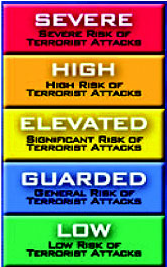 In some schools, you just know the principal is plain out crazy. They’ve been around for a while and have managed to circumvent the contract in almost every way. Even when RW goes over to rein these guys in, it doesn’t much help. Their vision of an educational workplace is simply not ours, and they just don’t care whose lives they’re stomping on. Those schools get a “Severe" alert.
You’ll find “High” risk of terror in some of the schools where they’ve just installed a Tweedle, one of those leadership people who haven’t come up through the ranks and probably just got out of grad school. They’re either totally new to the job or still feeling their way, so they haven’t been able to establish a record of unmitigated terror as yet.
A school with an “Elevated” level of terror means that you heard that someone down the hall got sent to the rubber room last week and no one knows why.
“Guarded” means that everyone should be looking over their shoulder, but particularly in the direction of a chapter leader who’s cozy with the principal.
I guess there are a few schools left with a “Low” risk of terror attacks, but only the Tier I people know what it’s like to be in one of those.
 Someone created a widget I’m thinking of borrowing, so you could plug a Real Time Terror Warning Badge box right into your own computer. Wouldn’t it be nice to know before you leave for school in the morning how much terror you can expect from admin when you get there.
“While there continues to be no credible information at this time warning of an imminent threat to the homeland, the department's strategic threat perspective is that we are in a period of increased risk.”
That's from the DHS website, but it sure feels the same way in schools. When teachers are seen crying after administrators have had words with them, when you hear someone’s been disciplined by a principal or AP even in front of students, when a teacher, or a secretary or a guidance counselor comes right out and tells you they can’t stand it anymore and this will be their last year, that they’ve had it, that they’ll never be around long enough to make good on the 55/25, then you know you’re in a terrorized school.
I know someone who got to be chapter leader for the first time about seven years ago. After a year of collaborating with her scalawag of a principal, she's had a rocky trip ever since: excessed twice, harassed (until the union jumped in and stopped it), and marginalized. She says the threat of being given a U-rating based on nonsense or sent to the rubber room on a trumped-up charge is always on her mind. With 20 years in the system, consistent satisfactory ratings and commendations, there’s never a day, she says, that she enters a school building without thinking: What bad thing is going to happen to me in here today?
I call that terrorization of the workplace, and I believe it is one of BloomKlein’s biggest legacies.
Re-read Mary Hoffman’s "Jack Welch is My Daddy", in which she talks a whole lot about how the CEO brought his “big stick” methodologies to Klein’s Leadership Academy.
This fall, the opening episode of the documentary about the Leadership Academy featured scenes from the ceremony for the first class of graduates. . . . Jack Welch played a role in the proceedings. When I saw him at the podium I wondered: would he wish the graduates luck? Tell them they could continue to call on him for advice and support? Thank them in advance for the years of public service they were about to embark upon?
“Get rid of your negative people,” he said.
. . . And who might those people be? Probably anyone who expresses skepticism about any aspect of the new curriculum. The official term used by the instructors at the Leadership Academy is “pushback,” and students role-play methods of dealing with it. A Joel Klein statement made in the course of the documentary is also instructive in this regard: he said one way the new principals could gauge their effectiveness was to ask themselves “...how much you are changing the system, and how much the system is changing you.” In other words, “good” graduates will not be altered from the missionary outlook the Academy has instilled in them; “bad” ones might allow themselves to learn something on the ground, even from people who don’t have the Academy’s seal of approval.
This is what some of us long-term educators are up against. We know pretty much what works in the classroom, but the autonomy and prep time it needs to get it done have been taken away. Every single time we do some "pushback," we run the risk of Klein's legacy, that you're not gonna be a happy camper if you speak up.
Andrea Gabor, in Strategy+Business, also reported on a tidbit of Jack Welch, who was addressing a class of principals at the Leadership Academy:
Jack Welch is pacing the floor of a large, window-less conference room in Brooklyn. Occasionally leaning against a table, the straight-talking former chief executive officer of General Electric Company alternates between haranguing and cajoling his audience of 60 or so middle managers. “Your job is harder than running a company,” Mr. Welch tells them. “’Cause running a company, you have all the bullets in your gun. Well, you have sort of a water pistol, I guess.” He pauses. “And it’s out of water.”
The room erupts in laughter.
“But you’ve got to find a way to put water in that pistol anyway,” Mr. Welch continues, almost shouting. “And eventually, put bullets in your gun.”
Does this kind of language have anything to do with education? Should teachers be afraid of what their principals will do to them next?
The BoE takes great care to protect students from verbal abuse (A-421), which they’ve defined in part as language "that tends to cause fear or physical or mental distress" and "tends to belittle or subject students to ridicule." But they've done diddlysquat to protect its lower level employees from similar kinds of mental distress and abuse.
There should be a method — and the union has really let this go on way too long — whereby abusive, terrorizing principals can be brought up on charges of Staff Abuse and put under immediate investigation. Witnesses could be summoned, statements from colleagues taken. Maybe it wouldn’t be feasible to detain these administrators in a rubber room, but certainly a representative agreed upon by the UFT and the BoE could be installed to watch over the culprit for a while until he stopped hurting people. That would send a message, wouldn’t it.
Maybe we’ve become too used to terror in the workplace, and maybe, if the union stopped collaborating for a moment, there’d be ways to turn this around.
----------------------------------------------------------
New from the lab: It's been a few days since this post first went up, and we're working towards a way to add the names of schools that are particularly dangerous to teachers. You should be able to know what you're in for before applying for a new job. Click on the alert to see the animated version we've been working on, and when you get to the new link, click on the buttons.

Postscript:
Before closing, I'd like give a shout out to the boys at the DHS, whom I've linked to above: How y'all doin' today?
 There's a merger a-brewing, GHI and HIP, and it's bound to hurt us.
You can get your feet wet on this issue over at Ednotes, but be prepared for a whole lot of bad news.
 Everyone and his uncle knows that the grievance system we had a couple of years ago was dismantled by the present contract.
In its place, a denial at Step I means that the grievant and UFT rep get to face off at Step II against the Chancellor’s rep (who runs the hearing), the principal (most likely phoning in from a remote site), and reps from the district and Human Resources.
At this point the whole thing, which seems pretty much rigged against members in the first place, comes to a complete halt unless the UFT grievance team comes riding in like knights in shining armor to take the case forward to arbitration.
I’ve had an overwhelming urge in recent weeks to re-acquaint myself with Article 22.C of the contract, which constitutes the arbitration process being practiced these days.
The essential points are these:
— A denied Step II doesn't, as mentioned above, go automatically to arbitration;
— You can’t get to the arbitration stage without going through the other steps (obviously), unless it’s a class size or group size issue or for some reason the Chancellor’s office missed the deadline at Step II;
— The notice of arbitration filed by the UFT gives a brief statement of the issue and the provision in the Agreement that’s been violated;
— The panel of arbitrators includes 7 people already agreed upon by the UFT and the Board to serve for renewable one-year terms. There’s a process for not renewing the services of any of these arbitrators at year’s end, and if a replacment arbitrator isn't installed in time, no problem: the same “normal” number of dates have to be scheduled in any case (in another process);
— The parties stipulate the facts beforehand where possible;
— They agree to make expeditious decisions and will not normally file briefs or order transcripts;
— The American Arbitration Association’s voluntary arbitration rules relating to the hearings, fees, and expenses apply;
— The arbitrator can’t go against or modify anything in the contract, cannot make any decision “involving Board discretion” in the contract (unless he feels the Board disregarded something in it, discriminated against the individual, or acted capriciously), and can’t interfere with the Board’s by-laws, etc.;
— The decision the arbitrator is final and the parties must abide by it;
— The arbitrator can determine a remedy, including back pay, but not a monetary penalty;
— The Board agrees to apply the arbitrator’s rulings in all similar situations, and UFT agrees it will bring no new grievances or continue any old ones that are similar to those already resolved by arbitration.
At the same time all this is going on, Article 22.D says that the Board can continue acting against you until the final decision comes down. Moreover, the UFT can't pursue a grievance on anything outside the contract without your consent (there seems to be a typo in that clause: D.2.: “in behalf”), and you get to retain any rights granted by other protections, like Section 15 of the NYS Civil Rights Law and the State Ed Law.
(Actually, I’m not sure about this last item, because that Section 15 seems to contradict the paragraph in section C.c., which says the arbitrator’s decision is “final”:
§ 15. Right of appeal not to be denied. . . . a citizen shall not be deprived of the right to appeal to the legislature, or to any public officer, board, commission or other public body, for the redress of grievances, on account of employment in the civil service of the state or any of its civil divisions or cities.
But, heck, I’m not a lawyer.)
What really made me look into this whole issue of arbitration more deeply was the an article by Stephanie Mencimer in the March/April issue of Mother Jones called “Don’t Tell it to the Judge,” which gives some background into what she calls an “arbitration trend” in this country.
She says that after the Supreme Court ruled in 1984 that Congress had created a “national policy favoring arbitration,” there was a dramatic increase in mandatory binding arbitration. That’s not our problem here, since we're not dealing here with mandatory anything, but what she says about arbitrators is very disturbing:
Justice Hugo Black once observed [that] arbitrators can be “wholly unqualified” to oversee complicated cases. Indeed, private arbitrators aren’t required to follow the law or established precedent, or even issue written decisions. Many have legal backgrounds, but there is no standard dictating that they be lawyers or credentialed in any way — yet their decisions can’t be appealed.
In a series of decisions, Mencimer says, courts have ruled “that an arbitration decision can stand even if it’s legally wrong and causes ‘substantial injustice.’” Furthermore, “courts shouldn’t review arbitrators’ decisions even when they are ‘wacky,’” and people challenging arbitration awards in court “ought to be sanctioned.” WOW.
If there is a national trend toward arbitration, it doesn't seem to be a positive thing, and we need to be vigilant.
Perhaps UFT management is being deliberately obscure on our grievance/arbitration process, not to mention way short on documentation, so that they can continue to play games and make private deals with the other side. In any case, there’s a whole lot of stuff we’re not being told much about . . .
. . . Like if it’s true what I heard, that the UFT and the Board have to agree on winning roughly the same number of cases.
. . . Like the names of the arbitrators, and their backgrounds. In the past, we used to go up against people we knew: the superintendent and their creepy little hit-people that came into the building from time to time. Tell us some more about these people, on the UFT website if you'd like, and prove to us you’re taking this seriously.
. . . Like the "normal" number of cases that grievance teams in each borough are taking to arbitration, perhaps even broken down by category.
. . . Like if the parties are supposed to stipulate the facts beforehand “whenever possible,” what reasons might there be for not being able to do this.
. . . Like if the parties would “not normally file briefs or order transcripts,” when would doing such things be actually appropriate and called for.
. . . Like when Leo Casey a couple of years ago — having already admitted that the UFT only takes the strongest cases to arbitration because of scheduling restraints (probably to keep the stats higher as well) — defended the UFT’s record of successful results this way:
As a general rule, the UFT has a very strong win rate at arbitration, with victories in well over half of the cases we take. This is considered a very high union success rate within the industrial relations field. Most of the credit for that rate belongs to our UFT grievance department, but it also indicates that the DOE is pursuing cases which should have been settled without arbitration, because the position on their side simply lacked merit. (Oct. 12, 2005):
then it follows that if many of the Board’s cases “lacked merit” way back in 2005, what must it be like now in this current free-for-all, where principals and administrators are having a field day with immoral and improper attacks and are being shamelessly backed by chancellor’s lackeys. Let's hear whether with all the increasingly aggressive, malicious, union-bashing, and possibly discriminatory Board practices going on, the union has started to balk at the limit on the number of cases they can take to arbitration.
. . . And another thing for Casey. He said back on Oct. 4, 2005 that the UFT was attempting to streamline things: "by eliminating a redundant step in the grievance process, in which the superintendent invariably ruled against the grievant, we have made some progress in this area.” Well, I was told by someone in the union only recently that the chancellor’s reps at Step II are ruling against members practically all the time, and that grievants should actually expect denials at that level. So, I’d like an update on the “progress” Casey thought the union was making , with some figures please, because it seems to me we’re just being blown out of the water by a higher level of blowfish.
. . . And lastly, if the arbitrators’ rulings must, as it says in the contract, be carried forward and applied to similar cases now and future, I’d really, really like to see a list of these rulings on the UFT website, so we all can figure out the substance and extent of this new era of post-contractual law.
 It is fascinating to watch bonobos in the Nova documentary Ape Genius make and use tools, copy tasks from other bonobos or humans, and work together to achieve goals they could not accomplish on their own, activities I had thought were pretty much reserved for our species alone.
The researchers were looking for why the human brain at some point “took off,” while the ape’s has remained incapable of the same kinds of complex cognition. Apes, they tell us, are like humans: they have culture and can learn from one another.
What experiments show, however, is that apes cannot teach. They have neither the passion for it or the mental skill. “Teaching locks in progress. There’s a cumulative quality over generations,” and this causes a “ratcheting up of complexity” in the mental processes.
 The program has scenes showing a human mother teaching a young child something about a new object. A triangular connection is established between the mother, the child, and the object itself. Both the mother and child point to or touch the object, talk about it, and share the wonderment of it; perhaps they incur an emotional response to the learning experience itself. Ape mothers do not have these moments with their offspring. Learning seems to go as far as copying, but no further.
The online interview with cognitive scientist Rebecca Saxe fills this out a bit:
Picture a parent and a child sitting together playing with blocks. In order to build something, both of them are adding pieces to the same structure. And they're negotiating about it. Which piece goes where? Does the tower go here? Does the door go here? And they're doing this project together. They have to negotiate it, and they have to play with each other at the same time that they're both playing with the blocks. That's the kind of coordination that humans do naturally. Two minds work together, watching each other and watching the object that they're playing with. That's the kind of thing apes don't seem to do.
Teaching someone a new trick, she says, is complicated:
One reason may be that you need to work out which parts of what you're doing need to be taught. So what's the difficult bit? How do you show it? How do you slow it down? You need to have enough awareness of what you're doing yourself to slow down the right parts in the right way.
Another possibility is that it's hard to work out the coordination of your attention and the other person's attention on this third thing — the task you're trying to teach. You have to pay attention to all three elements continuously. . . . There's this other thing, which is wanting to teach. That may be even more critical. You need to understand that somebody else can't do what you're doing, and also have some reason, motivation, desire to help that person learn it. That desire to teach seems to be really pervasive in humans and may be mysteriously missing in apes.
The ability and desire to teach may be innate to the human species, but the people running the school system, from BloomKlein at the local level right up through to the NCLB Congressional crowd, are gassed up on another evolutionary characteristic: the instinct for class and cultural dominance.
 These people have the means to take their own progeny right out of this system and put them elsewhere, in smaller, better-funded settings where the kind of teaching that separates humans from apes can actually take place.
In our apathy and fatigue, we at the lower end of the feeding chain allowed them to get into office, where they can design, promote, and install all kinds of educational programs that have no track record whatsoever and will allow only a minimalistic kind of achievement in much of the population.
I’d like to sit Joel Klein down in front of this show on apes to remind him that TEACHING in capital letters is a time-consuming, labor-intensive activity at which only humans excel. It involves a willingness and commitment on the part of the teacher and the learner to focus together on something new, to marvel at it perhaps, to evaluate and thoroughly absorb it. It needs the intimacy of smaller learning environments and a good amount of time to pass information effectively from one member of the species to another.
All the massive amounts of misappropriated cash into PR firms, high-end administrator jobs, test-making companies, and other self-serving money pits, all the scripted lessons and the pseudo-accountability systems will not add one whit to the skills of a good teacher or the success of a kid who has learned something. These come from the innate qualities of both, which get nurtured in the right settings.
It might be that what's different between humans and other animals is the quality and complexity and richness of the innovation.
As long as the people who manage this system are engaging in class wars and dominance strategies, what happens in our oversized, micromanaged, hypertested and time-wasting classrooms is not going to even approach the solutions to teaching that humans as a species have evolved over millions of years.
See also a relevant blog just posted Feb. 28th on Ednotes:"There's a major story here in NYC that the national press, in it's fantasy of the phony reform movement wants to ignore. It is about the immense failures of Bloomberg and Klein."

Norm posted a great article Monday on how the public is being pried out of public education in a massive kind of way. It's a summary of Steven Miller and Jack Gerson's report on "The Corporate Surge against Public Schools."
Miller and Gerson refer back to a response they had written a year ago to a report funded by the Gates Foundation et al., which had called for some pretty nasty things when you come right down to it, like replacing public schools with charter schools, eliminating the power of school boards and teacher pensions, slashing health benefits, and forcing poorly functioning kids out of education altogether.
That these people can sleep at night is beyond me.

Once you start breaking down local systems of education and turning ideology, management, and finances over to corporations and pseudo-philanthropists with national influence, you get ed-oligopolism. The super-rich supply the theories, and everyone else buys into them.
From Miller and Gerson:
They would leave education policy in the hands of a network of entrepreneurial think tanks, corporate entrepreneurs, and armies of lobbyists whose priorities are profiting from the already huge education market while cutting back on public funding for schools and students. . .
Essentially, this is a fight of and for the common man. The authors put it this way:The struggles of the Civil Rights Era made people realize that quality education was a right that everyone deserves. Education today, whether public or private, is a social policy. We make choices about how far it is extended, what the purpose is, what quality is offered, and to whom. Now that wealth is polarizing in this country, corporate forces are determined to create a social system that benefits the “Haves” while excluding the “Have-Nots”.
Privatizing public schools inevitable leads to massive increase in social inequality. . . If the corporate privatizers succeed in taking over our schools, there will be neither quality education nor civil rights.
The system of public education in the United States is deeply flawed. . . .The solution is not to fight backwards to maintain the old system. Rather it is to fight forward to a new system that will truly guarantee quality education as a civil right for everyone.
Central to this is to challenge [emphasis mine] the idea that everything in human society should be run by corporations, that only corporations and their political hacks have the right or the power to discuss what public policy should be. As Naomi Klein stated so well in The Shock Doctrine, privatization “will remain entrenched until the corporate supremacist ideology that underpins it is identified, isolated and challenged”. (p 14)
The real direction is to increase the role and power of the public in every way, not eliminate it. If we can spend $2.5 billion a week for war in Iraq, we can certainly build quality schools. It’s not a matter of money. The issue is who will benefit and who will control. Should schools be organized to benefit the super-rich, or should they be organized to benefit everyone?
Read Eduwonkette and all the comments in "It's a small world after all" on the interconnectedness of some of the players in this big ballfield. Listen to Chomsky's lecture "Class War: the Attack on Working People."
  Read The Shock Doctrine, Gerson and Miller's "Education and Commodity," William Cook's Unencorporating Education, and anything else that makes connections for you, so you can get a handle on this intellectual, political and class war. Just because you don't necessarily feel it yet doesn't mean it's not already all around you.
It's the struggle of our lifetime, really, because the outcome will define the way we think, the way we interact with (and maltreat) certain sociological groups, and the way we educate schoolchildren for years to come.


