July 21, 2023

Keeping track of the Aetna mess (part I)

I had to make a timeline for a workshop I ran, so thought it might be useful to put it up here. 

Much of this history I got from the PSC CUNY union website, particularly What’s Happening to Our Healthcare.  It all started in 2018, when the city shifted new hires from EmblemHealth to HIP
June 28, 2018 – OLR-MLC agreement set a $1.1 billion target in healthcare savings to be generated between 2019 and 2021, and “for every fiscal year thereafter $600 million per year . . . on a citywide basis.” Sustainability would need to be studied by special Committee. Eight large topics are outlined, but PSC says they only “seriously considered one, reaching for the low-hanging fruit: retiree health benefits” (see History and Timeline).


I'm skipping to . . . 

July 2021 – The massive restructuring was announced. By January 2022, the city would (a) move people by default into a MAP (an EmblemHealth and Empire Blue Blue Shield partnership called the Alliance), and (b) let them opt to stay in their supplemental care program if they paid a premium of $191.57/month.

Oct 2021 – LAWSUIT 1 (NYC Org’n of Public Service Providers)
Judge blocked this lawsuit over implementation: the city hadn’t established an accurate list of providers and sent retirees a flawed enrollment guide.
https://nysfocus.com/2021/10/20/retirees-flee-medicare-advantage/

                   LAWSUIT 2 (Aetna against the city, violations in the bidding process)

Dec 2021 – Judge extended injunction to stay implementation until April 1, 2022.

March 3, 2022 – Judge ruled that the city charging a premium would violate §12-126 of the city’s Admin Code (enacted 1967), which stipulates that “the city will pay the entire cost of health insurance . . . not to exceed 100% of the full cost of HIP-HMO.” City had argued it was following that law as long as it covered the full cost of one health plan, and that it could legally charge people a premium if they wanted a different plan. The city appealed and lost.
https://www.work-bites.com/view-all/retirees-win-in-court.  

July 18, 2022 – Anthem/Empire withdrew, ending this first effort.

Sept 8, 2022 – The MLC (which negotiates health insurance on behalf of city unions) agreed to propose a change to Admin Code to eliminate the HIP-HMO rate as single standard for determining city’s obligation to pay the full cost for employees, retirees, dependents. (In practice, when the cost of the Senior Care plan exceeds the HIP plan in a given year, the Health Insurance Stabilization Fund reimburses the city the difference.)  Under the new proposal, the city and MLC could agree on a different plan as the “standard” – or benchmark: for either retirees+dependents or for actives+dependents.
https://psc-cuny.org/news-events/psc-opposes-weakening-nyc-health-insurance-protections/

Nov 2022 – Appeals court rules retirees can’t be forced to switch to a MAP: Admin Code §12-126(b)(1) requires respondents to pay the entire cost up to the statutory cap of any health ins plan a retiree select.s
https://www.work-bites.com/view-all/retirees-win-in-court/

Dec 15, 2022 – Arbitrator cleared the way to switch retirees into a MAP (Aetna).
https://www.thecity.nyc/2022/12/15/23511966/mediccare-advantage-25-day-clock-from-abritrator-could-end-senior-care-innew-york-city

Jan 11, 2023 – Judge blocked the $15 copays.
https://www.nydailynews.com/news/politics/new-york-elections-government/ny-judge-blocks-nyc-charging-retired-workers-copays-20230111-4sbubgj6ujdgtlbjgytgbsfn2m-story.html

March 9, 2023 – MLC votes to accept Aetna MAP, as only alternative to HIP VIP (full Aetna contract not made available before the vote, but posted on March 10, 2023); City signs contract on March 30

May 25, 2023 – Appellate court affirmed Judge Frank’s Jan 11 decision blocking the copays.
https://iapps.courts.state.ny.us/nyscef/ViewDocument?docIndex=T7cQMiFRJdpEmd_PLUS_lMgmasQ==

May 31, 2023 – LAWSUIT 3 (NYC Org’n of Public Service Providers)
Seeks temporary restraining order against the Aetna plan, saying NYC violated city charter by not offering choice and violated state and city human rights laws prohibiting discrimination against disabled people. It also failed to follow proper procedures.
Documents: https://iapps.courts.state.ny.us/nyscef/DocumentList?docketId=_PLUS_IDYK0flEDapsoEVXJNmnw%3D%3D&display=all&courtType=New%20York%20County%20Supreme%20Court&resultsPageNum=1&fbclid=IwAR0LUAbRq8dHnk2C6YhIYmHeICHViyH8MjfiGEP9ahNglx2pWJn7wB-oRu0
About it: https://www.nydailynews.com/news/politics/new-york-elections-government/ny-nyc-retirees-sue-to-block-mayor-adams-new-medicare-advantage-plan-20230531-bnhtvbxonvfrle3gqwflqx5cxy-story.html

June 8, 2023
 – Comptroller declined to register the Aetna contract because of pending litigation.
https://comptroller.nyc.gov/newsroom/comptroller-lander-declines-to-register-medicare-advantage-contract-pending-litigation/

July 7, 2023 – Judge issued temporary injunction blocking the move: the city can’t order retirees off the current plans.
https://psc-cuny.org/news-events/judges-decision-temporarily-blocks-aetna-medicare-advantage/
Court document:
https://law.justia.com/cases/new-york/other-courts/2023/2023-ny-slip-op-32251-u.html/

I guess to be continued . . .

July 14, 2023

The biggest bog of all

A few months ago CMS issued its first guidance on the drug pricing controls legislated under the Inflation Reduction Act of 2022, and revised it last month (here). As everyone knows, Medicare couldn't until this legislation negotiate any drug prices with the industry – the VA being the only agency able to that – so I was hoping that the new law would remove those shackles quickly and irrevocably. 

But alas, only some changes looked promising (see the full timeline here), among them being: 
  • 2022 – rebates to Medicare if certain Part D drug prices increased more than inflation
  • 2023 – insulin caps ($35 a month per prescription)
  • 2023 – free vaccines for seniors
  • 2023 –  rebates to Medicare and lower coinsurances for certain Part B if prices increased more than inflation
  • planned for 2024 – no copays or coinsurances for people in the “catastrophic” phase of Part D.
Also in the timeline, spread over many years, is the IRA’s new Drug Negotiation Program for dealing with overpriced drugs. It looks grindingly slow.

They’ll select the first 10 high-priced drugs – really? only 10? – in 2023, letting us know the negotiated prices for these in 2024, and putting the new pricing into effect in 2026. In 2025-2027 and 2026-2028 there’ll be two more groups of 15, and 2027-2029 another 20. More specifics in the new guidelines, but I don’t know how anyone could think this slow-mo program is fair to consumers.  

The city is wanting to move us from Express Scripts into SilverScript. There’s no premium for either of these plans. The laws governing the healthcare components the city has to pay for do not include drug coverage, so we get “riders” for medications through our welfare funds.  The SilverScript rider will be cheaper than the current one, but it's still more expensive than the normal Part D plans in our local area. That's because most employer-negotiated plans have “open” formularies, which means all drugs are included, some in expensive tiers. Premiums for “closed” formulary plans cost less because certain brand names and higher tier medications are excluded altogether.

An interesting group called PissedConsumer has published some polling on which plan people like better, Express Scripts or SilverScript. Apparently they’re both disliked pretty much the same. 


The sample of people polled is small, but it does not reflect contentment.

Both Express Scripts and SilverScripts are actually not plans but Pharmacy Benefit Managers. I first heard about PBMs in a recent chat with my local pharmacist, though most of what he ranted about quite honestly went right over my head. The gist of it was that middlemen PBMs play a huge role in the distribution chain, and lots of the other components — patients, pharmacies, insurers, employers, other payers — just have to play along.

According to an April 2019 post by the Commonwealthfund, 
“PBMs are companies that manage prescription drug benefits on behalf of health insurers, Medicare Part D drug plans, large employers, and other payers. By negotiating with drug manufacturers and pharmacies to control drug spending, PBMs have a significant behind-the-scenes impact in determining total drug costs for insurers, shaping patients’ access to medications, and determining how much pharmacies are paid.“

Here’s the graphic they adapted from a Congressional Budget Office document of January 2007:


The only thing I can figure out in this picture is that the PBM is dead center, big, and I won't be getting a handle on most of this in my lifetime. 

Here’s what I did got from the rest of the article:
  • Rebates from the manufacturers (not publicly disclosed): Should PBMs be able to keep these or pass them through to insurers, who could then reduce premiums and copays? Pass-through amounts don’t always reach small insurers or employers. Reform would require PBMs to pass through rebates to patients. Reform would also require more transparency so federal and state policymakers could see what’s going on.
  • Spread pricing: in the case of generics, insurers and employers reimburse PBMs more than what the PBMs actually pay pharmacies for these. PBMs keep the difference and the schedules are “kept confidential” from the health plans. Reform would ban spread pricing altogether, so that insurers and employers would not overpay. 
The recurrent themes in what I've been reading are the lack of transparency, the use of opaque contracts to maximize profits, shorting pills, selling patient data, misrepresentation, covertly shifting patients to higher-priced drugs, the pocketing of manufacturer rebates, and similar bad practices. Bottom line: nobody can figure out what’s going on. 

Katherine Eban writes in a Fortune magazine article of Oct. 28, 2013: 
Express Scripts vehemently insists it saves money for clients and that the vast majority are satisfied with its service. And like any company – to state the obvious – it’s entitled to a profit. The question is, Who is making out better – the PBM or its customers? Many experts say the former. They argue that many companies stick with traditional PBMs because drug pricing is so impossible to untangle that customers have no way to verify how much they’re saving, if anything.   ...  The PBMs’ claims of cost savings are difficult to prove or disprove. Drug pricing is an almost impenetrable bog.
She quotes a PBM auditor as saying: “The nation’s employers are being taken for a ride.”

And she says a VP of one of the more transparent PBMs puts it this way: “Basically it’s a ‘confuse-opoly.’ Buyers don’t understand the PBM industry, and that’s why they hire consultants – who don’t understand it either.” 

You’ll be paying different copays for your drugs in SilverScript. That’s what I found out when I priced my expensive drug over the phone at the number the OLR has been giving out for questions about the new plan: 1-855-648-0389. Maybe you’ll have better luck, but one of mine ended up way more expensive in the new SilverScript plan than what I’ve been paying in Express Scripts.

And the thing is, I’ll never know why.


July 11, 2023

Brian Lehrer (WNYC) needs to do better

Granted this move to shove all of us retirees into Medicare Advantage is a huge topic, but if you’re going to bother to do a half hour on the temporary hold, please try harder next time.

Lehrer started yesterday’s segment with a sentence filled with disinformation:

“NYC government retirees – 250,000 of them about – have been bracing for, if not dreading, a major change in health care coverage from traditional Medicare with supplemental coverage paid for by the city to a privatized Medicare Advantage plan run by Aetna.”

Nope. 

Not all 250,000 retirees have been “bracing for” or “dreading” this major change, because not all of them have a “traditional Medicare with supplemental coverage” at this time. Just the ones in Senior Care, who don’t want to lose this arrangement where the city picks up the cost of a Medicare supplement and they can stay out of Medicare Advantage. The class action lawsuit says there are 183,000 retirees that have Senior Care, which leaves 67,000 who don’t.

The city actually offers at least seven plans to retirees living in the metro area, and other plans for people who live elsewhere. In the new arrangement, people in one of these, Emblem HIP VIP Premier, would have been allowed to keep it. 

The Emblem plan is already an Advantage plan, the most restrictive kind because it’s an HMO. I’m sure tens of thousands of people are currently enrolled in it, since it’s been around longer than the decade I’ve been retired. Maybe they’re in it because they had a version of it when they were working and didn’t want to change anything once they moved into retirement. Maybe they’ve kept it because Emblem is a private company and not publicly traded like Aetna, relying on its reputation as a non-profit insurer. In any case, I don’t think any of these retirees are doing any “dreading” or “bracing.” They seem to be getting the care they need.*  
*Saying that, I have friends who switched to Senior Care because a specialist they wanted was not not taking the Emblem plan. So, it’s not that these people got delayed or denied service, but they didn’t want the restrictions in choosing a provider or facility and preempted the situation.

The instructions for the July 10th deadline said do nothing if you wanted to keep your Emblem HMO and only let them know if you wanted to switch into the new Aetna PPO. 

Lehrer mentioned that only 1,600 retirees had opted out as of last week, but he did not tell us how many people chose to keep the Emblem HMO they have. Nor did the reporter on the show (Caroline Lewis) correct him, to clarify that a fair percentage don’t have Senior Care, but the Emblem plan. This omission skews the whole issue, because I suspect the thousands who decided to keep the HMO are either happy with it, or didn’t trust the transition to the new Aetna, or were just taking a “wait and see” position until November, when they’d have another chance to make a coverage change. 

Reporting on only part of the whole scenario is kind of like malpractice. The show made it seem like the all the city retirees are in same class action, whereas it’s only the ones who are losing Senior Care. As for the others who have the Emblem HMO, nobody is telling us how many of those people decided to keep what they have. That’s just bad reporting.


There was also some confusion relating to the cost of Medicare and supplements people would have to buy if they opted out. 

Responding to Lehrer’s question “What’s the cost for those additional city health benefits” if people do opt out, Ms Lewis must have just misunderstood the question: 

“Paying for the premium for Medicare Part B on your own and not having it through the city I think starts at around $165 and goes up depending on your income ... people might want to pay for a Medigap plan ...”

He was asking her about the cost of the “additional” benefits, meaning the ones Senior Care gives you, not Part B. Part A is free for most everyone, and she's right that there's a premium of around $165/month for Part B, more when income is higher. It's paid to Social Security and city retirees get that reimbursed if they remain inside the city system. But Lehrer wasn't asking about Part B, he was asking about the "additional" coverage they'd have to get if they were to opt out.

This almost obligatory extra coverage is not something that "people might want to pay for," as Ms Lewis says, but something they'd be a fool if they chose not to. Medicare leaves so many costs on the table that you need to have supplementary coverage, which can come through a Medigap, resembling Senior Care. There are 10 different kinds of these in the open market, with several companies in each zipcode competing for your business. Checking the plan finder at the NYS Dept of Finance for this month's choices in the metro, they range in price from the most comprehensive, never-see-a-bill type at $332/month to a high-deductible kind at around $68/month. (People could also supplement Parts A and B through a premium-free Advantage plan, but why would they want to do that when the city is offering Aetna PPO at no cost. That would be utterly stupid.)

Admittedly the subject is turgid and inscrutable, but the questions and answers on this program showed neither the interviewer or the reporter was up to the task.  So disappointing.


July 8, 2023

What a mess. Full stop.


That’s the email we got yesterday which proves at least one thing: the UFT knows how to keep us informed efficiently, clearly and rapidly when they want to – or when their back’s up against a wall.

The whole health care swap is on hold again now that the court has granted a preliminary injunction “enjoining the City from forcing retirees to switch from their existing healthcare benefits, and from being required to either enroll in an Aetna Medicare Advantage Plan or seek their own health coverage.”

Anyone can follow the reporting by googling it, but I’m most interested in some of the wording used in the legislation and rulings through the filings and appeals. NYC Admin. Code §12-126 is not entirely clear in the very first paragraphs. The first problems come in the definitions of “coverage” and “payment”:
a. Definitions
iv. “Health insurance coverage.” A program of hospital-surgical-medical benefits to be provided by health and and hospitalization insurance contracts entered into between the city and companies providing such health and hospitalization insurance.
and
b. Payment of health insurance costs
(1) The city will pay the entire cost of health insurance coverage for city employees, city retirees, and their dependents, not to exceed
one hundred percent of the full cost of H.I.P.-H.M.O. on a category basis.
No mention of “premiums” here. It says the city will be paying the “entire cost” of the coverage defined in clause a.iv. not to exceed the “full cost” of the HIP HMO, which could easily be interpreted to mean it would include copays and coinsurance in addition to premiums. Costs could also include the $50 deductible that Senior Care people have to pay out of pocket before the plan starts picking up Part B leftovers mounts, as well as the $300 deductible ($750 max per year) for each benefit period of in-patient service and the $50 deductible for an emergency room visit.

Judge Frank didn’t help when he quoted this ambiguous part in yesterday’s ruling:
... to this Court, section 12-126 does appear to be a codification that the City must pay “the entire cost of health insurance coverage”... the Code makes no mention of the word “premium” but rather uses the word “coverage.” 
What?  Is he saying the Code uses “coverage” for “premium” when these two terms do not equate? You pay a premium to get coverage.  He might have meant the Code doesn’t use the word “premium,” only the word “entire cost,” but who knows.

Apart from what costs the city is supposed to be covering, there’s also a problem with the phrase “on a category basis,” which even the appellate court ruled was unclear in November last year. It said “further evidence is necessary to determine, for example, the meaning of the phrase ‘on a category basis.’”

Judge Frank’s ruling yesterday was sloppy in the following excerpt, and not only because of two typos.  Writing about the Code, he stated just before the passage I already quoted above:
This section provides that “[t]he City will pay the entire cost of health insurance coverage for city employees, city retirees, and their dependents ... [typo 1, end quote missing] To this Court, this wording is unambiguous [Really? It’s ambiguous to me if you can’t tell from the wording whether “entire cost” means just premiums or premiums plus all the other costs in the plan] and applies to this matter. Moreover, the history of section 12-126 shows that the City intended to provide all retired employees health plans and intended to assume full payment for them. [Again, “full payment” to me means premiums plus the rest of the costs, not just premiums.] Gardener Aff., Ex. H at 27-28. This section was originally enacted through the City’s expanded powers, under a 1965 amendment to [NYS] General City Law § 20, passed around the same time as § 12-126, empowering the City to pay the “for [typo 2, I think it should have been “pay for”, not “pay the for”] premium charges for supplementary medical insurance benefits under the federal old-age, survivors and disability insurance benefit program.” ) [I don’t have access to the Gardner affidavit, but the § 20(29-b) of NYS General City Law he’s citing doesn’t use the word “pay” for premium charges. Instead, it says cities are empowered to “reimburse”retirees for premium charges. There’s part of the payment mechanism in here that’s not at all clear to me, since retirees can’t be “reimbursed” for something they never paid for in the first place. And if the judge is bothering to explain this history, he certainly left out an explanation of how “costs” in the Code got reinterpreted to mean just “premiums” by the NYS law.]
Wouldn’t it be nice to have somebody at any level of the judicial system clean this mess up.

Apart from all this and getting back to the Definitions clause above, it’s clear that the “health insurance coverage” as defined by the Code does not extend to prescription drugs, even though all of Part D is done through “health insurance” plans similar to medical plans. In fact, if you don’t have drug coverage for 2 months through some kind of health insurance plan, Social Security will slap you with a penalty that never will go away. Drug coverage is an essential part of health care. Without drugs, some people can't stay alive. Without drug coverage, some people can't afford to stay alive.

Not defining what “costs” are involved with coverage, not clarifying the term “category basis” at all, calling bits of legislation unambiguous when ambiguity clearly remains, and making strange word substitutions like the ones mentioned earlier doesn’t help us understand anything.

I’m going to be staying out of these court docs from now on. They’re really upsetting. 

But, I’m not intending to stop writing about how retiree insurance works, because I think most people haven’t the vaguest idea – of course through no fault of their own. It’s really a dumbass system we have in this country.

July 6, 2023

A tug of war, right?

Clearly there’s a struggle in the health care industry, with so many combatants and such high stakes. Market forces running the insurance companies, providers swamped in paperwork and burning out, patients hurt by delays or being denied services outright, hospitals struggling or or even closing, top staff seduced by high salaries, drug prices off the charts, unions and employers buying into health plans that will save them money, and racial and social injustices playing a part in all of it. 

This post continues where I left off a couple of days ago, on just one aspect of the problem: prior authorizations. How do the players in this massive tug of war over priorities deliver and receive excellent medical services at a cost people can afford in work environments that don’t destroy people's souls. 

Myndshft's definition of the practice is pretty good:
a utilization management practice used by health insurance companies that requires certain procedures, tests and medications prescribed by healthcare clinicians to first be evaluated to assess the medical necessity and cost-of-care ramifications before they are authorized.
But not all of Medicare requires them.

Original Medicare Parts A and B hardly at all.  It’s assumed that providers ask Medicare to pay for what is medically necessary, and in fact, the 1965 SS act that created Medicare, didn’t authorize any form of these at all (according to the CMA).  It’s only subsequent legislation that allowed prior auths for some services and equipment. Saying this, Medicare started requiring a “pre-claim review” process for nursing homes in some states, ostensibly to combat fraud, though one report says 90% of the errors were not from fraud but from not enough documentation.

Medicare Part D is a whole other story, as the plans are not governmental, but offered competitively by non- and for-profit companies. They decide for themselves which drugs on their formularies will require prior auths and which won’t. More likely it's the Pharmacy Benefit Managers making decisions these days, not the companies themselves.

Medicare Part C – the Advantage plans (MAPs) – are also run by non- and for-profit companies, which in their capacity as middlemen between patient and government, have rightfully earned the contempt many people have for them. Their delays and denials of service have become scandalous, their procedures and paperwork burdensome to providers.
IMPORTANTLY, there’s not much information about how prior auths are used, how often it's denied, and how reviews affect patient care and cost (KFF, May 2022).
So we don't really know what’s going to happen with the new Aetna plan. But there’s enough literature out there from CMS, the AMA, and a slew of advocacy organizations to highlight what's gone wrong and where changes have to be made.

What's gone wrong

The flowchart in Myndshft's prior authorization guide (paraphrased below) is a good place to get some understanding of the process. They're talking about a prior auth for a lab test here:


All the manual procedures in this process, the rule changing, the individual requirements of the various plans, the monitoring from start to finish, and required notifications are simply overwhelming. The AMA claims that doctors in private plans, Medicare Advantage or not, spend 16 hours a week on prior authorizations.         

Apart from the absurd magnitude of these middleman procedures, other things have gone wrong.  According to a Dept of Health and Human Services study reported in April 2022:
  • Prior auths are sometimes delayed or denied in spite of meeting Medicare coverage rules (13%) or meeting both coverage and billing rules (18%). Some plans deny because of stricter criteria than Medicare itself uses, or ask for more documentation than Medicare.
  • Most denials in their sample were caused by human errors in manual processing and system errors in the software (e.g., incorrect programing).
  • Some denials were reversed after a patient filed an appeal –  I read somewhere else that only 11% of patients go to the trouble – while others were reversed when the plan itself found it had made an error.

But can anything be done?

While Medicare for All lumbers its way through Congress, people are calling for change in the systems we have now. In May 2022, KFF advocated regulating everything having to do with prior authorizations and making them more transparent as well. Some progress, they say, has been made in at least the following areas:
  • CLINICAL COVERAGE:  As a case in point, California now requires companies to use criteria “consistent with generally accepted standards of care and ... developed by a nonprofit association for the relevant clinical specialty.” It’s unfortunate, thought, that KFF says state laws like this wouldn't apply to employer-sponsored plans, nor would they, I assume, for retiree plans.
  • TRANSPARENCY is apparently gaining momentum. There’s a House bill requiring Advantage plans to report which treatments need prior auths, and to give %s of approvals, denials, and appeals.  This kind of reporting had already been written into the ACA, but alas and alack, according to KFF, it's been largely un-implemented. 
  • SETTING STANDARDS for prior auths. For example, the ACA had already banned them in emergency care. A new Michigan law now standardizes methods and demands transparency reporting. What interests me is the new “gold card” laws, whereby health plans have to waive prior auths requested by doctors with a track record of approval. Believe it or not, the first one seems to have been enacted in Texas, of all places (discussed here). 
  • ADMINISTRATIVE REFORMS.  A bill that passed the House last fall – H.R. 3173 “Improving Seniors Timely Access to Care Act” would amend Title XVIII of the SS Act (which created Medicare in 1965) “to establish requirements with respect to the use of” prior auths in Advantage plans, including electronic submission, attachments, real-time decisions, declaring which ones would be routinely approved, data collection, transparency, etc.  Impressive: it has 326 co-sponsors, but too early for champagne.  It’s been sitting in not one but two committees for a couple of years ... 

I'm sure I won’t be seeing Medicare for All in my lifetime, but I like that doctors associations  and legislators are trying to fix some of the scandalous parts of Advantage plans as we know them, even if the shareholders and a lot of bad actors are contaminating the battleground. 


July 5, 2023

Pausing on Aetna to talk about PNHP


As I mentioned in my response to some comments, I write these health care posts to clarify some of the terminology and issues that have been tossed around over the past two years – energetically and purposefully, but not entirely accurately.

Even though NYC retirees only have a few more days to decide whether they want to opt out of the new plan immediately (it will start Sept 1 if the lawsuit against it fails), you’ll be able to move in or out of it again in November, and each year thereafter. I know some people who are waiting to see what will happen in the rollout, then jump in if major problems haven’t been reported once it’s up and running. 

One “major problem” I’m half expecting is that some doctors will not immediately accept the plan because they’ve never heard of it before. I’m also keeping my ears open for the results of prior authorizations, about which I don’t expect to hear much because Aetna must know it has to be on its best behavior with regard to these and won’t deny (m)any of them in the first half year. Time will of course tell.

But as I also mentioned in other posts, I strongly believe in changing the country’s tax structure to get universal single-payer, and this is where activism is key. Letters, contacting government officials, taking to the streets, sporting pro-Medicare-for-All messaging on self and car, and anything else you can think of will help raise awareness, and discontent.

For the armchair activists in the crowd, Physicians for a National Healthcare Program (PNHP) just sent around a brief survey, prefaced by this letter from the president:
I know what I think of Medicare Advantage (MA), the large and growing program that invites insurance corporations to manage benefits for what is now a majority of people on Medicare. Of course, these corporations use money that should be going to patient care to pad their own bottom lines. Wall Street sees this program as a financial windfall, and they’re totally right.

But policy aside . . . I’d deeply appreciate it if you took a few minutes to share your perspective . . . [and] I also hope you’ll share the survey with your friends, family members, and neighbors, so we can develop a truly broad-based understanding of the program.


Digital version here.

Print version here.
PHNP’s mission statement involves advocating for universal, comprehensive single-payer national health insurance, and joining with other groups to fight racism and advance social justice.

You don’t need to become a member to see their research materials or watch their video analyses of our profit-driven American health insurance structure, a couple of which live at these links:
Medicare Advantage: What single-payer advocates need to know

Upcoding, Medicare Advantage, and DCEs

Dr. Ed Weisbart on Direct Contracting Entities

Try 'em out. The techie ones really get into the weeds.


June 30, 2023

Prior authorizations, there's the rub


I have to respond to a couple of comments made after my last post. For starters:
“People want to be in traditional medicare vs this version.”
So many people still think that Senior Care – the GHI/CBP plan that many retirees have and are trying to hold onto – is “traditional Medicare.” It’s not.

Traditional Medicare (Parts A and B) is run by the federal CMS with money from two trust funds – replenished by payroll taxes and Congressionally-authorized monies – and premiums (hhs.gov). As everyone knows, Medicare doesn’t cover all medical costs, far from it. There remain deductibles, copays and coinsurances, which are paid by the seniors themselves, or by their employers, a private insurance company, or the government. Even when people do buy a supplemental plan, they mostly still have to pay some things out of pocket.

The OLR has been offering retirees a choice of such plans, the most popular of which, I guess, has been Senior Care GHI. In a lot of ways it acts like a private market plan (a Medigap), but the city has negotiated it to include a general medical deductible, a fee-structure for hospital stays, and copays – none of which exist in market Medigaps.
What the commenter is really saying is these retirees want to keep the supplemental Senior Care plan and not be shoved into an Advantage plan.


The next part of the comment is balderdash:
“In essence you are repeating what Mulgrew keeps claiming - aw shucks it’s still medicare and I wish we could just call it that instead of that badly misnamed Medicare Adv — Mulgrew would call it wonderful medicare.”
Even if Mulgrew did say what’s being claimed here, it’s not worth all that much. He’s shown no deep comprehension of the way Medicare works or he’d have been explaining it better and cutting out all the PR. No one believed him when he said “We will continue to monitor its implementation” (The Gothamist): there are doctors who have still not heard about the new plan yet, and others are saying “Absolutely not, we’re not taking any Advantge plans.”

But where the commenter says:
“I think you need to qualify the differences in how med and Medadv are administered.”
that’s half right.  I haven’t really spelled out in recent posts how billing works with Traditional Medicare.

In the Traditional scenario, providers submit bills to Medicare for processing. According to Kaiser, “for most payment systems ... Medicare determines a base rate for a specified unit of service, and then makes adjustments based on patients’ clinical severity, selected policies, and geographic market area differences.” The remaining costs get forwarded to the supplemental plan, and the enrollee gets billed for what’s left to be paid. Prior authorizations virtually do not exist: this is mostly a fee-for-service situation.

I did touch on how Advantage plans work on my June 19th post, but I’ll be more specific here. Per capita amounts are sent to the Advantage plan companies (I said that), who design their own packages based on Medicare rules and government regulations (that too), but can deny coverage for certain services (and that in a different way). It’s these potential denials, based on a structure of prior authorizations in Advantage plans, but not in Traditional Medicare, that terrifies some retirees. (Not all retirees: me and some of my friends are in Advantage plans and have been getting the care we need.) But I acknowledge that the scandals surrounding Advantage plans have too frequently involved denials of coverage (for the reasons on the left, from DHHS, April 2022).
Parenthetically, I’m pretty sure the newer scandals will at some point involve upcoding:
Upcoding occurs when a health care provider seeks reimbursement using a fraudulent CPT code that provides a higher reimbursement than the CPT code which corresponds to the services actually rendered to a Medicaid or Medicare patient.

An example of upcoding would be if a doctor saw a patient for a routine check-up (which has a CPT code with a reimbursement of say $60), but when billing Medicare the doctor provides the CPT code for an extended check-up, which provides a reimbursement of $100. (Kohn, Kohn and Colapinto)
and in the Part D side of Medicare (stand-alone drug plans or drug components inside of Advantage plans), watch out for Pharmacy Benefit Managers (PBMs):
Pharmacy Benefit Managers (PBMs) are third party companies that function as intermediaries between insurance providers and pharmaceutical manufacturers. PBMs create formularies, negotiate rebates (discounts paid by a drug manufacturer to a PBM) with manufacturers, process claims, create pharmacy networks, review drug utilization, and occasionally manage mail-order specialty pharmacies. In light of rising health care costs, the role of PBMs are being reviewed due to the cost of prescriptions drugs and the effects on consumers. (NAIC Center for Insurance Policy and Research)
Here’s what our new Aetna brochure on prior authorizations says you can expect from the plan, some of which is no surprise (like cosmetic and experimental services), but some are pretty scary for people who have serious conditions and are afraid of delays and outright denials:
Compare the above the list to the city’s Medicare Advantage Plus plan of 2019, which gave 32 (!) outpatient procedures needing prior authorizations. What might be considered “normal” senior outpatient services – like endoscopy – don’t seem to require prior auths in the new Aetna plan. I actually confirmed one or two of them by phone with Aetna a couple of weeks ago. The physicians will just book the procedure and that’s that.

Back to the comments:
Who ya gonna call when there’s a problem? Right now we call Medicare. After Sept 1 we call Aetna and their most probable non-unionized, lower paid and insentivized staff to help profit motive.
Energetic, but not true. When there’s a billing problem, you don’t always have to call Medicare, and even with Advantage plans, a conversation with the doctor’s office and/or the company itself might find a coding issue, which can be fixed by correction and resubmission. Other times, the doctor has to supply more information, which annoys them no end, but the purpose is not always maniacal.

I don’t know anything about “non-unionized, lower paid and insentivized staff” on the decision panels, and I’m sure the commenter doesn’t either. What I’m reading is that there are rules on who can authorize or deny: “The ultimate decision on a prior authorization request rests with a clinician — a physician or nurse — who works for the health plan to which the request was submitted. All final denials or redirects commonly are decided by a clinician at the insurance carrier.” Another report says the “prior authorization is then reviewed by clinical pharmacists, physicians, or nurses at the health insurance company. Somewhere else I read that any of these people can approve a procedure, but only physicians can deny one.

But there have been so many complaints about access to care that CMS had to act. Last April it issued a final rule that will take effect in 2024 to address these. Here are some main points relating specifically to medical prior authorizations in Advantage plans (choices and numbering mine):
The final rule clarifies clinical criteria guidelines to ensure people with MA receive access to the same medically necessary care they would receive in Traditional Medicare. Specifically, [1] CMS [requires that] MA plans must comply with national coverage determinations ... local coverage determinations ... and general coverage and benefit conditions included in Traditional Medicare regulations ... [2] when coverage criteria are not fully established, MA organizations may create internal coverage criteria based on current evidence in widely used treatment guidelines or clinical literature made publicly available to CMS, enrollees, and providers  ... [3] streamlines prior authorization requirements, including adding continuity of care requirements and reducing disruptions for beneficiaries ... [4] all MA plans [are required to] establish a Utilization Management Committee to review policies annually and ensure consistency with Traditional Medicare’s national and local coverage decisions and guidelines ... [5] approval of a prior authorization request for a course of treatment must be valid for as long as medically reasonable and necessary to avoid disruptions in care in accordance with applicable coverage criteria, the patient’s medical history, and the treating provider’s recommendation.
“The rules are designed to ensure people with MA plans get access to the same necessary care – prescriptions, medical tests, equipment, and procedures – they would receive in traditional Medicare” (Fortune.com).

For the rest of the comments left on yesterday’s post:
By the way, the GHI emblem plans we’ve had I am told is for a non-profit agency.

I also think to talk about how the money moves and the amounts Aetna gets from medicare to cover costs and profit. And that the admins of Medicare have nothing to gain personally compared to Aetna — say the person you deal with has employee stock options. So to blandly say Medicare Advantage is just medicare without qualifying comments is misleading.
I have never ever said Medicare Advantage is “just Medicare,” because I’ve always been a single-payer kind of girl and still wear my Bernie tee-shirt to prove it. But I do have things to say about for-profit and non-profit health insurance companies, and will save those for another day.

June 27, 2023

Choices

I need to clarify something I said yesterday, that at this point we have to “jump on board or get run over” by the Medicare Advantage juggernaut.

I was not talking about abandoning activism against the health insurance industry. 

You can stand up against Advantage plans and all the other corporately designed arrangements for managing Medicare and still want to get the best coverage for yourself at the present time.

The “juggernaut” I referred to in yesterday’s post is the health care apparatus the city has been trying to push us into for the past couple of years. They developed the Empire and Aetna PPOs behind closed doors, rolling out the first one poorly, and not convincingly fixing all the bumps in this new one. (Are you sure all your doctors will even take this new plan, or will you be denied some procedures you used to get in Senior Care without a problem?)  Neither plan has been capable of earning our complete trust.

That’s because these things are negotiated plans, and the city has only negotiated the terms of the Aetna one to last for two years. What will happen to individual parts of the coverage after that is anyone’s guess. 

Protest as much as you want at the rallies, like the one of a few days ago at the introduction of legislation to stop the Aetna plan from going through. Join other campaigns for single payer, like the very active Physicians for a National Health Program and National Nurses United, or all the other groups supporting the Medicare for All bills in the House (HR1976) and Senate (S1655). Donate to Public Citizen, or to legislators like Sanders and Jayapal. Read and support the work of people like Wendell Potter, who rails against the Medicare Advantage industry, Pharmacy Benefits Managers, and the any other corporate invention that sucks millions out of public funds. 

But  while you’re taking to the streets and sending money to causes, you still have to figure out which coverage arrangement best suits you right now. I don’t see any way around this.  There’s only a couple of options, and you need to sort through them. 
 

If you let yourself be placed into the new Aetna PPO (presuming it gets through the lawsuit), you’ll still be in Medicare, but in addition:  
      •  You’ll get pretty decent in- and out-patient coverage for “normal” senior health conditions.
       • You’ll get reimbursed for your Part B premium and IRMAA surcharge. (Last year Part B was $2041 a year per person, and additional IRMAA amounts were calculated in tiers of income.)


If you opt out of the new plan, you’ll still have Medicare, but: 

       • You’ll have to get supplementary coverage through one of 10 different kinds of Medigaps on the open market. These pick up some or most of the remaining Part A and B costs, but don’t include drugs or extras (like an annual physical, meals after surgery, etc.). Under no circumstances should you choose an Advantage plan. That would make no sense whatsoever, as the MAPs offered by employers and unions usually have better coverage. 
      • You will not get reimbursed for Part B or IRMAA. 


If you keep the HIP VIP HMO, things will stay as they are, including the reimbursements  for Part B and IRMAA. 


Any way you go – taking one of the two Advantage plans (Aetna PPO or HIP VIP HMO) or opting out altogether – you still get:

      • Drug coverage if you purchase the drug rider (from January 1st, $103.50 a month with the Aetna plan, roughly $180 with the HIP)
      • Dental, vision and hearing aid help through the Welfare Fund. No premiums, just union membership.
      • SHIP reimbursements for quite a few health-related services, with a $100K lifetime cap. It costs $120 a year. 


That’s it, folks. The good thing is that you can change your mind every fall.  The bad thing is, there’ll still only be these same choices. 

Unless the lawsuit succeeds, of course. We’ll have to then see what they come up with next.


June 26, 2023

The juggernaut's comin' at you

As an advocate of a
 country-wide single-payer health care system, I sympathize with the protests and lawsuits against the city for pushing us municipal retirees into a Medicare Advantage Plan.

MAPs are just another way that corporate entities get to fleece one of the country's service sectors. 

Think charter schools.


But it’s not a bad idea to remember that most workers don’t get employer retiree coverage at all. Freelancers are also out there on their own.

So who do these people turn to when they have to navigate this minefield of a health care system just when they’re entering the most vulnerable decades of their lives. It's one hot mess of corporate and political interests out there, much of it directed at survival of the fittest.

Social Services mostly don’t have time for any but the lowest incomes. Brokers are of course always looking for your business, and a few communities may actually have some volunteer counselors. The bravest among us will turn to the online plan finders to search for available health plans on their own (you can find them at Medicare.gov and NYS). You need a tutorial and some real patience with all that. All of this to figure out something that matches your current pocketbook and your projected needs. It's the country's self-inflicted form of Russian roulette.

Putting our situation into perspective, Kaiser FF reported that last year that only 13% of large employers (with 200+ workers) were actually offering retiree health coverage at all. Half of that group gave their people Advantage plans, and 44% of that subgroup didn't let them choose between MAP and non-MAP coverage.

Currently the dozen or so plans we've been able to choose from are a mix of HMOs, PPOs and supplemental arrangements like GHI Senior Care (they're listed here on the OLR website). So come September 1st, NYC will be one of the few large employers offering retiree coverage at all, and if they clear the court challenges, they’ll be limiting the choice to a couple of Advantage plans and offering no non-MAP alternative at all. Check those three Kaiser boxes.

More data from Kaiser shows that retiree health plans are more likely to be offered by companies with over a 1000 workers, that they're public employers (63% offer retiree coverage), that they belong to certain industries (government being one of them), and they’re unionized. 88% of these extend coverage to spouses as well. We here in the municipal unions can tick all these boxes too.

I guess you could say we’re lucky – especially since they're reimbursing our Part B premium (including the IRMAA surcharge when our incomes are high enough to get these), refunding us some extra things through SHIP, and keeping up some financially beneficial Welfare Fund arrangements (e.g., dental plans, reasonable drug costs). Few American retirees get what we get.

Yet, I'm still against Medicare Advantage, which has been around under different names since Medicare became law in 1965. That’s because Medicare’s original design was imperfect and people really needed help with the leftover costs, like deductibles and the 20% of Part B we have to pay for ourselves. Private companies stepped into that void pretty quickly, and there they were again in 2006 lobbying their corporate heads off to control the whole of the newly created Part D.

As long as lobbyists and legislators block changes to the tax structure that might get everyone in this country access to the health care they need no matter where they live, work, retire or breathe, this is the system we got.

I’ve been doing Medicare work for almost a decade and am amazed at the new structures corporations have been allowed to design and push through Congress just to keep single-payer from ever happening in this country. How many of these things do you actually recognize?
Accountable Care Organization
Direct Contracting
ACO Reach
Medicare Shared Savings Program
Pharmacy Benefit Managers
etc.
I could go on, but it’s giving me agita.  As laymen, we won't be understanding any of these schemes any time soon, but these guys are working overtime to get at our cash reserves.

So best of luck with the lawsuit. The juggernaut has been heading right at us for years, and I hate to say it, but at this point we gotta jump on board or get run over.


June 23, 2023

Tighten up the messaging, please!


Updated 6/25: I had to add a no. 7 below . . .


I want to comment on some things in the press release Norm included in advance of the rally yesterday against the new Aetna plan.

It’s only a C+, and that's because of the lousy messaging. You can’t tell if they really know what they’re talking about, for example here:
This legislation is a simple bill that requires the City to offer ... a Medigap plan to supplement Federal Traditional medicare as they have had for 56 years.
What Pizzitola and her organization almost get right is their demand that the city offer a plan to supplement what Medicare doesn’t pay for.  What is dead wrong, though, is that that the current Senior Care is not a Medigap plan. It is a hybrid, chunks of which smell very much like an Advantage plan.

Medigaps are issued by private companies to cover some or most of the deductibles, copays, and co-insurances that Parts A and B of Medicare have never covered from the get-go. As you can see in the chart on p.2 here, there are 10 Medigap designs, created by the feds and administered by the states in various ways.

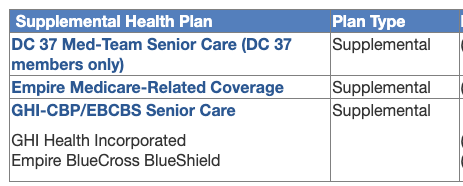
Employers and unions negotiate various types of supplemental coverage for their retirees, but these are not Medigaps.  In fact, the Senior Care plan that so many city retirees have has been called “GHI/CBP” for at least a couple of years. “CBP” stands for “Comprehensive Benefits Plan” – not a Medigap at all, but a plan the city negotiated with GHI and Empire that equates to some, but not all, of the coverage that the most expensive Medigaps offer. 

Here’s the description of Senior Care from the OLR website:


And here’s how Senior Care is not a “Medigap.” 
• One. There’s a $50 deductible above Medicare’s annual Part B deductible.  Medigaps don’t have deductibles in themselves. Their job is to cover some or all of Medicare’s deductibles. 

• Two. There’s a $300 hospital deductible per admission ($750 max for the year).  Medigaps don’t work that way. Some cover the whole Part A deductible ($1600 this year), others cover a percentage of it. 

• Three. You enhance your Senior Care hospital benefit to 365 days with a rider. All Medigaps give a 365-day benefit, it’s how they’re designed. 

• Four. Senior Care included an annual physical. Neither Medicare or Medigaps cover an annual physical.

• Five. In late 2021 members got a letter saying there would be $15 copays for common services. Medigaps DEFINITELY don’t do that. (And I know, the city rescinded these later, but they negotiated this and wanted these to happen.)

•  Six. On a phonecall last spring, the UFT Welfare Fund referred to Senior Care as a “PPO.”   PPOs are Medicare Advantage plans, not Medigaps.

• Seven. Senior Care is premium-free, the city negotiated it that way for union retirees.  But all Medigap plans have premiums. The most comprehensive ones cost the most, particularly in NYS.
Getting back to that darn press release . . . 
To preserve retiree health care choice, the City shall offer . . . at least one Medigap plan with benefits equivalent to ...

Medigaps do not have benefits, at least not in the form of services.  They only pick up remaining costs.

For months, retirees have ... rallied to bring attention to the fact that they will be forced off their current Medigap plan and Traditional Medicare losing access to their doctors, physicians, and treatment facilities.

A. Retirees don't have a Medigap at the present time. They have a negotiated plan with some elements of Medigaps.
B. The implication that retirees are going to lose their doctors, physicians (same thing as doctors in my book – what’s with that?), and treatment facilities is a grossly hyperbolic. Not one person who authored this release knows what will happen. All they're doing is terrifying you.

This legislation will allow them to maintain access to Federal Medicare and their doctors ...  This legislation ... also preserves Medicare,

We will all maintain access to our Medicare, and we don’t need new legislation to “preserve” it. We’ll keep paying premiums into Social Security, and CMS will continue to determine what the plans must cover and must do. What Pizzitola meant is that city retirees want to keep Original (or Traditional) Medicare and have the city pick up the remaining costs with the equivalent of a standard Medigap.

Remember, Advantage plans like the new Aetna PPO can (and frequently do) offer more than what’s in Original Medicare. Annual physicals and SilverSneakers are two easy examples, and pp. 123-56 of this .pdf list many benefits not covered by Medicare that will be covered by Aetna (e.g., meals after inpatient discharge, monetary rewards, transportation, allowance for OTC items, some money for a hearing aid,  etc.).

... they are enabling a for-profit insurer access to NY taxpayer dollars at the expense of the retirees! 

Honestly, who do the Pizzitola protesters think the insurance company behind Senior Care is? It’s EmblemHealth, and sure, the company bills itself as a non-profit, but CEO Karen Ignagni is “working to benefit health insurance companies” and in 2021 made $3,095,534 (Crains). 

You tell me what defines a not-for-profit company these days. One contributor to medium.com writes:

Not distributing its profits to any private individual is the crucial difference between nonprofits and for-profits. Besides that, the executives of the system still get salaries and salary raises. In reality, the term “nonprofit” is misleading, as numerous nonprofit organizations even take in millions of dollars annually and consistently run in the dark. 
and Elisabeth Rosenthal reported in Stanford Medicine several years ago:
To some extent insurers do better if they negotiate better rates for your care. But that is true only under certain circumstances and in a limited way. “They are methodical money takers, who take in premiums and pay claims according to contracts — that’s their job,” said Barry Cohen, who owns an Ohio-based employee benefits company. “They don’t care whether the claims go up or down 20 percent as long as they get their piece. They’re too big to care about you.

 As far as I can see, it’s all just one big game. 

Our job is to push for reform – that’s where I do agree with the press release. But for heck’s sake, please do something about the messaging. I’m so tired of reading stuff that looks more like Swiss cheese. 


June 21, 2023

Will it fly?

After posting my take on the UFT’s trust issues (June 17th), where I wrote:
On June 8th we learned that the Comptroller declined to register the Aetna contract, something that UFT brass claimed a few days ago is not actually needed. Huh?  They read the Comptroller’s objection as more of a stance.

Could the Comptroller stop the city from moving forward with this plan? 

According to the Daily News:  No, he can’t, because the Mayor can override it, which he did last Thursday, the 15th:

Mayor Adams used executive authority Thursday to enact his controversial Medicare Advantage Plan for the city’s retired municipal workforce — overruling Comptroller Brad Lander, who has refused to sign off on the private health insurance switchover.

Last week, Lander announced he had invoked a rare comptroller authority to block Adam’s contract to shift the city’s roughly 250,000 retired workers into an Advantage plan administered by private health insurance giant Aetna. 

This is the kind of exact information I would have preferred at the retiree meeting. Instead we got spin.

Within the past couple of days we found out that the city has delayed the opt-out time for the new plan from June 30th to July 10th, and as usual we’ve not been told why. Even if they did give an excuse, I’m not sure I would believe them. 

After all, there is that rally Thursday to support the introduction of legislation requiring the city to offer a Medigap plan, not to mention that at last week’s UFT meeting we learned that not all the members had received a welcome package regarding the new plan. That kind of sloppiness has happened before. Heck, it’s even happened when they send out ballots that somehow don’t arrive in my mailbox. 

A lot of people are still opposed to Advantage plans. Joe Maniscalco’s article in Work-bite cites quite a few comments about the city’s full-throttle support of this Aetna Advantage plan, and I’m in total agreement with all the bits in bold:
Jeff Johnson, former head of the Washington State Labor Council, AFL-CIO and co-president of the Puget Sound Advocates for Retirement Action [PSARA], tells Work-Bites Medicare Advantage programs and ACO REACH plans allow corporate America to “fleece the Medicare system by taking excessive administrative costs and profits from what would otherwise be money available for expanded services for Medicare beneficiaries and for lowering Medigap premium costs.”

Stu Eber, president of the Council of Municipal Retiree Organizations [COMRO], says . . .  “Our tax dollars should not be going to a company that is under multiple investigations for fraudulent practices.”

UFT retiree and CROC member Martha Bordman calls Medicare Advantage an “insurance racket,” and says it’s “heartening to hear the comptroller recognizes this, and is showing integrity by not rubber-stamping the Aetna MA contract.”
We’re in a wait-and-see moment, whether the UFT can pull it off this time round.

As for myself, have been in the HIP VIP HMO for years. No problems, so why rock the boat when we’re not sure if this new thing will fly.