 Summertime for me usually means reading Tom Stoppard, but let’s face it: There’s nothing like Shakespeare to help you understand the mind of a despot.I’m talking about Richard III, though I’m sure anyone who knows me probably thought I meant Michael Bloomberg.
When Al Pacino came out with his documentary Looking for Richard in 1996, he had spent four years poking around the soul of that hideous king. The film is fascinating if you’re looking for insights into the psychology of New York's ruling class. Take the remark Vanessa Redgrave makes in the film, that "those in power have total contempt for everything they promise, everything they pledge,” and then review the list of Bloomberg statements about running for a 3rd term:
 "The people themselves have twice explicitly voted for term limits. We cannot ignore their will. They want the openness new faces bring. And they will get it. We will not go back.” (2002)
“I would oppose any change in the law that a legislative body tries to make.” (2002)
“There’s no organization that I know that would put somebody in charge for a long period of time. You always want turnover and change. Eight years is great. You learn for four years. You can do for four years." (2002)
"I think it would be an absolute disgrace to go around the public will." (2005)
"I always thought term limits were a good idea. I am not trying to overturn term limits." (2008) [credit to www.youreadisgrace.com]
Contempt, yes. There's also the greasing. For example, the Independence Party — “Asked if the mayor had pledged a specific amount of money to support the party this year, Salit was understandably coy. The mayor had assured them that ‘ample resources will be brought to bear,’ she said with a smile. In Bloomberg talk, this is always a seven-figure number.” Or the people who find real estate projects a piece of cake these days — look at image 2 in this link when it zips by, which shows how they're planning to build 4 big towers in the Coney Island acreage that’ll block the sun for the next 200 years.
Barbara Everett, a Shakespeare scholar Pacino interviews in the film, suggests that "Everybody may have a price, but for a lot of people there is a fundamental decency. It takes quite a long time for them to reach that point. The action of the play, the sense of exciting movement, is Richard's finding the point" — or in real time, the moment the pandering and corruption stops.
Bloomberg may be getting his kicks from straddling the line between legal and illegal, moral and immoral. He certainly doesn’t need the cash.
Richard, Everett continues, is "bound to be left alone, because nobody can love the king beyond the degree of their own egoism, or perhaps their own goodness. There’s going to be a point.”
Well, New Yorkers are sure waiting a long time for that point, the one when enough legislators and council members break away from the mayor’s contemptible grip to vote for something relating to public education that makes sense. It hasn't happened up in Albany, and it's not happening down here either. A few perhaps, but not enough of them.
Says Richard when Buckingham asks him to make good on his promises:
"I’m not in the giving vein."
Neither is Bloomberg. He’s locked out parents and educators for eight years, and if he’s handing them a few crumbs this past week, it’s because he was forced to. He wants that third term.
 Al’s producer, Michael Hadge, suggests Richard is a man who in the end “knows that he does not have his own humanity. That he’s lost it, that he has let the pursuit of power totally corrupt him, and that he is alienated from his own body and his own self.”
To my mind, so is Bloomberg, else how could he as a Jew compare anything going on in the Senate these days to the failed policy of appeasing the Nazis. That’s losing your own self big time in my book.
At the end of the play, King Richard comes to terms with his self-loathing, and he doesn’t hide behind a cloak of insanity when he openly convicts himself in Act V, scene iii:
"Alas, I rather hate myself
For hateful deeds committed by myself.
I am a villain.
Every tale condemns me for a villain.
And if I die, no soul shall pity me.
Nay, wherefore should they?"
I think Bloomberg’s not there yet, because he’s still an arrogant son of a bitch. But as Everett says about Richard, "Although he’s frightfully clever, he’s at the same time like a kind of boar who has subsumed into himself all these frightful animal images. And all the rest have got to do is hunt the boar, and that’s what they do. And they get him."
We’ll never be able to “get” Bloomberg for the crimes he’s already committed against half a generation of NYC school children. But we can get him OUT, for as Richmond puts it:
"England hath long been mad and scarred herself." (V, v)
Not one shred less than New York, methinks, when scoundrels rule and people beflower the paths they tread.
 Scott Stringer is sinking us.
I wrote him this morning out of disgust, particularly after taking a look at his website and learning he no longer needed the services of the clearest thinking man on Klein's PEP, Patrick Sullivan.
In my letter, I basically asked him what about mayoral control so pleased him these past 7 years.
As far as I could tell, it's been:
• chaotic (three reorganizations of the heirarchy in 7 years, busing fiasco,etc.),
• faked (manipulated test scores, an inscrutable school grading system, etc.).
• non-transparent (no-bid contracts, hidden liaisons with corporations, etc.),
• dictatorial (shutting parents and educators out of decision-making, the firings at the PEP meeting a couple of years ago over the tests, etc.), and at times
• irregular or unlawful (appointed an uncertified and non-educator chancellor who needed a waiver, broke up the districts into regions without court approval, etc.).
The borough president is not elected to do a mayor's bidding, which is what checks and balances are all about, and since we haven't had any checks and balances for the past seven years on mayoral dictates, Manhattan expects Stringer to start showing some muscle.
A full-out rejection of this mayor's irregularities, arrogance and downright incompetence running our schools would be a good start. Insisting that long-term educators get to make the important decisions should be another priority. At least they know in their bones that parent input counts.
What Stringer thinks about education can be read on his website. In light of his decision to continue backing mayoral control (a position he's taken all along, according to Lisa Donlon), I am concerned that he's become deaf to his own words:
However, there is widespread discontent with the councils and, in 2006, the Borough President released a report [Parents Dismissed] showing that the CECs have not received the support and training the DOE is supposed to provide in order to allow them to be effective.
He's also taken away our best shot for keeping the DoE clean. Failing to re-instate a real advocate for public education on the newly constituted board, we now get his general counsel (Jimmy Yan). What did tossing Sullivan get him? The public really wants to know.
Here's the part of Stringer's position paper that shows how well Bloomberg's PR machine achieved its primary goal, getting elected officials to believe the fabrications and not bother themselves with with due diligence.
New York City’s public school system has seen some improvement in recent years: in certain grades student achievement on standardized reading and math tests has posted notable gains; a modest gain in the high school graduation rate has been achieved; there is an ambitious capital plan that seeks to address overcrowding and facility deterioration; the number of gifted and talented and bilingual programs has increased; and additional accountability measures have been put in place.
Despite this progress . . .
. . . The chancellor has called tackling this achievement gap the major impetus behind new accountability and assessment measures and the most recent re-organization of the system.
In fact, the test score gains and graduation rates have all been debunked, overcrowding is worse than ever (they're still using trailers for classrooms), and there's no sign of a single instrument of accountability or assessment that doesn't leak like a sieve.
If as Stringer says "far too many students lack the most basic skills in reading and math" and "70,000 students each year do not graduate on time," keeping the BloomKlein edifice in place makes no sense. Unless you've sold out for something bigger.
It remains to be seen whether these changes in structure and funding will help close student achievement gaps. Likewise, it remains to be seen if the City’s new pilot program to pay parents and students for improved standardized test scores and good attendance will improve student performance.
If Stringer needs more time to see that this mayoral control thing isn't working, then Manhattan will definitely need to cut him loose.
 Over at GEM this week it was predicted that Bloomberg would quickly try to burnish his image once a report called The New Marketplace got published on Wednesday. The New School study showed that the larger high schools have not fared well during Tweed’s slash-and-burn strategy to create more and more small schools.
As it turns out, Bloomberg obliged and did mount a press conference at one of the big high schools: Truman — way up in the north Bronx. Accompanied by some very high-profile people, including Commissioner Kelly, the chancellor, UFT prez Randi Weingarten and her heir-apparent Michael Mulgrew, the mayor felt a strong urge to talk about the drop of crime in the city’s public schools.
I guess he chose Truman because it was one of the two large HSS cited favorably in the report under the heading “Leadership and Stability Matter”:
Some other large high schools managed to handle the side effects of school closings and growing numbers of new students without severe disruptions. Those with strong, stable leadership and a solid core of high-achieving students have been especially successful in coping with sharply higher enrollments. . . And when enrollment boomed at Harry S. Truman High School, there was initially a steep decline in attendance and graduation rates, but the school managed to rebound.
 At some point during the conference, Bloomberg referred to a number of handouts graphing the decline in "major" crimes (burglary, grand larceny, and grand larceny auto) and "violent" crimes (homicide, rape, robbery, felony assault, misdemeanor assault, and sex offenses) in schools.
When a reporter asked why anyone should believe the numbers, Bloomberg apparently shot back something like: “Are you saying I’m lying?”
To which I'd have responded: “Duh!”
First, everyone knows there’s underreporting of incidents, by teachers and administrators. In the “gotcha” climate wrought by Tweed, no one likes to report incidents unless you have to — for insurance purposes. Sometimes it’s a matter of sullying the school’s image or your own. After all, if an incident happened while you were around to see it, maybe you weren't doing something right. I don’t know whether principal’s bonuses are affected by the number of incidents they report, but they may be. There’s also a question of being afraid to make a false statement (Did I really see that?), and in some cases fear, retaliation, and/or blowback.
Let it be known that both the UFT and the DoE use the word “incident” for a broad range of negative behaviors. Included in the union’s list are: “assaults, classroom disruptions, threats, and violent or dangerous behavior.” The official DoE Incident Report gives the following definitions on page 2:
 In both lists, classroom disruption and misbehaving are as much “incidents” as are assaults and violent behavior, and that’s weird. Remind me to file an incident report next time Johnny tells me to f... off when I tell him to stop pawing a girl and get to class.
It’s actually a little confusing to match Bloomberg's graphs with the comment made by Criminal Justice Coordinator Feinblatt in the press release:
Thanks to the collaboration between the Department of Education and the police, we have reduced the behaviors that disrupt our classrooms and hallways and prevent our students from concentrating and learning.
Someone really has to explain what the "behaviors that disrupt our classrooms and hallways” have to do with homicide, rape and other violent crimes — or, in fact, with the NYPD at all.
Behavior is controlled by good security leadership (which Truman has, I understand), adequate space to place kids while they calm down or serve suspensions, and most importantly, enough staff — aides, agents, and teachers on patrol — to do the job, inside the classroom and out in the common areas. Not all schools have all three, and they may very well suffer for it. For Bloomberg to leave teachers out of the security equation is strange. The press conference was by invitation only and it was reported only two teachers were in the room. That’s interesting, and distressing.
Getting back to the reporter’s question on the credibility of Bloomberg’s numbers, there’s this:
Massaging data to support a favorable school governance record has been a trademark of Klein’s chancellorship. In fact, it’s what the Tweed PR team actually do best.
Look how they've already manipulated test scores, school grading, and graduation rates — statistics that congressmen and city council members seem to accept without question regardless how frequently their conclusions have been shot down by ed analysts like Jennifer Jennings (aka Eduwonkette) and Fred Smith, historians like Ravitch and Meier , and brainy activist parents like Leonie Haimson (Class Size Matters).
Thank you, Mr. or Ms Reporter, for asking Bloomberg that question about believing his numbers. Maybe it made them think twice about broadcasting the conference all over the news.
And maybe the press is just not buying this stuff anymore. Fingers crossed.
Which brings me to Randi Weingarten, who once again greeted the mayor with a kiss.

Does that mean the new contract’s already in the bag?
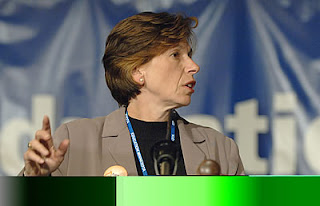
 If you had a chance to read Randi Weingarten’s speech at the May 9th UFT Spring Education Conference, you might have thought the union president was preparing to run on the ICE ticket in the next election.
Because it's bits like these that have been central to ICE discussions for years, that problems in the schools have to be addressed within the context of larger social communities and that teachers should never be scapegoats for problems over which they have very little control:
It’s time for a new strategy — one that of course focuses on instruction, but also aims at the root causes of chronic school failure, one that addresses the needs of the community and its families. . . .
What would happen if we not only acknowledged that there are conditions in children’s lives that make it harder for them to learn, but actually did something about it?
And:
The learning process itself depends first and foremost on the smarts and sensitivity of the teacher – the teacher who must discern how each child learns and have at her fingertips a panoply of strategies, materials and resources to provide just the right combination that will get through to each child. . . .
And that’s why, for reforms to be successful, they must be developed with teachers, not imposed on them.
But many influences merge in that moment the teacher reaches into her bag of tricks (actually, her reservoir of accumulated skills and knowledge) and comes up with just the right instructional solution.
Some of these influences are out of the teacher’s control. . . .
Teachers alone cannot cure a child’s asthma or repair a stormy family situation.
In fact, Weingarten's new “comprehensive school turnaround model to serve our neediest children in our most challenging educational settings” — she’s calling it ACES, Active Communities Enabling Success — smacks of the election platform ICE wrote back in 2004.
That document was put together by more than twenty dedicated, politically savvy educators with enormous classroom experience in New York public schools. I’m not going to post the whole thing here because there's a link to it on the ICE website in the left side column.
I don't want this union leader to go one step further casting herself as a visionary of ed reform without making it clear that the essential points of the program she’s introducing originated not in her own Unity caucus, but in the opposition — the same opposition she's taken great pains to marginalize and deride in the past few years. For proof, just look at the way she wrested the HS seats from ICE/TJC in the last election and the way she manipulates procedures at the delegate assemblies to get the votes to go her way.
So when Weingarten says that smaller class size is one of the things “we are still fighting for today," let’s remember it took her many years to make class size a real priority. In 2004, ICE not only pushed smaller classes in its platform, but criticized the Unity strategies that undermined them:
Small classes are the underpinning of an effective classroom, and are especially crucial where children have low performance levels and special needs. . . .
Our union leaders continue to undermine the fight for lower class sizes by:
— Not successfully tying class size to learning conditions.
— Adopting the strategy that a referendum was the only way of lowering class size. . .
— Continuing to support out-of-classroom positions which in fact contribute to large class size because it diverts money for pedagogical personnel away from the classroom. Included in this are the thousands of facilitators, mentors, staff developers, coaches, and teacher center personnel.
— Supporting currently mandated programs and strategies from the DOE, multiple grouping, balanced literacy, and the new math program, which are impossible to implement with class sizes over 18 to 20.
Our union’s position on class size should be:
— Class size limits comparable with other districts in the state and capped by contract
— No half-class size loopholes, and no excuses in overcrowded buildings where classroom teacher-student ratio can still be lowered.
And when Weingarten trumpets the importance of teacher input and skill in statements like these:
The learning process itself depends first and foremost on the smarts and sensitivity of the teacher — the teacher who must discern how each child learns and have at her fingertips a panoply of strategies, materials and resources to provide just the right combination that will get through to each child. . . . And that’s why, for reforms to be successful, they must be developed with teachers, not imposed on them. . . .
Teachers would be allowed to unleash their amazing creativity.
she not only hasn't protected us from the micro-management of our classrooms, but has for the most part condoned it. (Has anyone ever won a grievance under Article 24 for interference in the way we want to teach? That thing has absolutely no teeth in it, and she knows it.) ICE had to remind Weingarten in 2004 that she could be doing a lot more to protect us from zealous administrators trying to make their bonuses:
Basic trust in the professionalism and knowledge of teachers. The current school “reform” is premised on a distrust of teachers (as well as any independent-minded local school leadership) with change to be commanded from the top supervisory levels. Our union leadership is allowing the DOE to violate Article 24 of our contract, which states, “The Board and the Union agree that professional involvement of teachers in educational issues should be encouraged”, and provides procedures to work out differences between teacher and administrative judgment. With the DOE model, decisions about instruction are made prescriptively and through packaged programs, and place enormous restrictions on a teacher’s ability to service the needs of individual students.
— Teachers must have a say in what goes on in the classroom, a contractual right that is presently violated by the DOE.
— Teachers’ own practical knowledge should be the basis for change, rather than one-size-fits-all program.
— Planning for instruction and curriculum reform should be arrived at through respectful relationships among all staff.
On testing, Weingarten says that the ACES network she's proposing
would not shy away from accountability. But it would seek broader metrics than just test scores and graduation rates to measure its success. It would ask such questions as: Is the school safe? Do children come to school every day? Are they healthier, more engaged? Are they critical thinkers and problem solvers? Are they involved in community service? Are their parents active in the school?
Come on. ICE and many others have made this point all along — not to mention the fact that whenever she's given credence to test scores and school grades, she’s buying into the DoE’s corpothink. And she gives credence to these all the time (see here, for example). Here’s ICE in 2004 on testing and long-term education goals:
Ending the misuse of city- and statewide tests, which increasingly distort the curricula and misrepresent true academic performance. Standardized test results can be a tool for evaluating instruction and pointing out where extra resources should be focused. But the current accountability model with its simplified goals and objectives results in students and teachers alike becoming prisoners of the achievement numbers game. This model also ignores any accountability for long-term learning goals or the kinds of learning that might give educators and students cause for satisfaction.
Good teachers develop an awareness of how children actually learn. The premise that children will learn more when they are subjected to weeks of teaching-to-the-test methodologies, that they become more successful students when strict standardized levels are set for them, or that they respond positively to threats and punishment are ideologically driven beliefs, contrary to what we know as experienced educators. An additional consequence of high stakes testing is that those children most in need become a liability to a school which then leads to an attempt to pass them off to another school instead of addressing their needs. . . .
— Teachers must play a primary role in judging student levels and progress from elementary school through high school.
— Students should have the opportunity to demonstrate their learning in a variety of ways.
Weingarten is now envisioning schools as hubs of community involvement. I guess she was unaware how much ICE has been advocating broader services for kids and fostering strong relationships between schools and the communities they serve:
Our long-term teachers could be a valuable resource in reaching out to the community and together formulating models for success.
And:Using teachers’ knowledge of their students’ communities as a basis for building successful schools. This includes the culture, history, experience and knowledge which the families and communities bring to this process. Neither the DOE nor our union leadership has an appreciation for how spending years, or even decades, working in the same neighborhood might yield valuable knowledge. Union leaders support the assumption of the school system managers that teachers are replaceable parts and will be fine with that as long as they have transfer rights and the guarantee of a job . . . somewhere.
Remember this was written way before Weingarten negotiated a contract that allowed for the ATR debacle.
Weingarten has always pushed PD, oblivious to how inappropriate so much of it is. In this speech she says teachers “would help shape the professional development they need" and help deliver it.
Sorry, but ICE already called for that years ago:
Meaningful professional development. Presently new and less experienced teachers are not allowed to grow into good teachers. They are not given the opportunity to try strategies and take risks. Ill-prepared and poorly trained administrators, coaches, regional personnel (some still politically appointed), have reduced professional support to a checklist with the intention of instilling fear and intimidation. The UFT has allowed these methods to distort teacher training and leave teachers open to attack.
— The UFT should be demanding school-based professional development determined by teacher need.
Lastly, does Weingarten think she’s saying something new when she concludes that:
As a community, we can let teachers teach and managers manage, but we can also help one another. We can make all our schools work for all our kids by pitching in together, not walking away and leaving the hard work to others.
I hope not. Because ICE laid it all out quite clearly five years ago.
Our union must stand up to the scapegoating of teachers for the problems of our school system. It must work to build coalitions of teachers, parents, active community members at the school and citywide level, and employees of other city agencies so that we can’t be played off against one another by the mayor and Department of Education.
We need a union that will lead and fight for an education system that meets the needs of all the students in our city, an overwhelming number of whom are poor and of diverse racial and ethnic backgrounds. It would take enormous changes and massive resources to correct the inequities in our society, but well-run schools with well-trained staffs, good programs, supportive services and small classes can bring about improvements for all children. To think that communities with vast economic and social differences can succeed with identical monetary resources is a mistaken notion and a popular political ploy.
The union leadership must be ready to expose such lies and not allow failures in our society to fall squarely on the backs of teachers and our union. Our union must also challenge all the various schemes to destroy public education by diverting money to private schools through vouchers, to DOE-funded charter schools or by hiring private companies to run public schools, which can only further polarize both our educational system and our society.
I challenge anyone to claim that Weingarten is forging new paths with her ACES proposal.
There only two innovative thoughts in this whole speech: that Bloomberg has ever been willing to take responsibility for the troubles in the schools ("In fact, even the UFT admired Mayor Bloomberg’s willingness to take responsibility, and many of us still do") and that this mayor and this chancellor are ever going to enter into any "collaborative, coordinated, comprehensive school turnaround model" with the union, educators and school communities any time soon.
UPDATE: See the end of this post for an important link. That was what they chanted at the May 14th rally against School Closings. And they're dead right. No one should be closing schools without fixing them.
I see it as a kind of gerrymandering.
If in politics you manipulate the boundaries of an electoral constituency to get a desired electoral outcome, the mayor and his ed machine at Tweed have built an entire apparatus for shifting tax dollars to private entities.
They've manipulated scores and designed a non-transparent, highly suspect school grading system.
They skipped the next step, which would have been to change what's not working in particular schools. Instead, they just closed them down.
Or broke them up.
They've rabbit-punched the contract, defied laws and mandates that got in their way (e.g, special ed violations, no-bid contracts, state graduation requirements), marginalized the parents and kept them guessing. All in a day's work.
In other words, make failure, declare failure, then throw money at charters, foundations and big business to create a new set of schools with new rules, not all of which are in the public interest.
This mayor is not for New Yorkers. He's from and for a class of people who want to keep another class of people out of power, and that's gerrymandering.
The NYCLU put out a report on May 14th called "Civil Rights, Transparency, Accountability Suffer Under Current Mayoral Control Scheme." Here's what Exec. Director Donna Lieberman said in an email NYCLU members received just today:
The current regime of absolute, unfettered mayoral control is incompatible with a safe, effective educational environment. For our schools and our children to be as successful as they can be, parents must be a part of the educational process and the core democratic principles of transparency, accountability and public participation in government must be respected. The Legislature must close the loopholes that have given Mayor Bloomberg and the Department of Education unfettered discretion over education policy.
The report documents the NYCLU's
. . . tremendous difficulty in obtaining basic data and records on these issues from the DOE and NYPD through the Freedom of Information Law. The NYCLU’s experiences are not unique. The DOE routinely withholds from parents, the media and elected officials raw data on student performance, student safety and the education budget. . . .
Under the current mayoral control system, Mayor Bloomberg and the DOE flout state and local statutes intended to assure public oversight of agencies with rulemaking power. For example, new Chancellor’s Regulations – rules that affect the lives and education of New York City’s children – are never subject to the 30-day public notice and comment period required by the City Administrative Procedures Act.
Among the eight changes they're calling for are these: (a) delineate the position of the DOE within the existing structure of city government, (b) increase public oversight, (c) strengthen the parental voice in policymaking, (d) allow for public engagement in the decision-making process, (e) mandate data transparency, and (f) create an Inspector General to protect integrity, conduct independent audits and investigations, etc. These are for starters, to restore the public trust.
Back to that rally . . .

You can read about it on Ednotes (thanks to Norm Scott), watch it on YouTube, join GEM (Grassroots Education Movement) like so many groups have done, and do some homework on the corporate takeover of public education and the people from Obama on down who are guilty of orchestrating the educorp coup.
And most importantly, you can be there for the next round.
FOR ANOTHER ALERT ON THE SELF-MADE BLOOMBERG CRISIS IN PUBLIC EDUCATION, see Ednotes. A couple of excerpts:
. . . Absolute power corrupts absolutely. Our federal and state governments have checks and balances so no one person has total control, which is a synonym for dictatorship. . . . Under this mayor, charter schools get the best of everything, including small classes and new technology.
. . . We need a chancellor who works for the kids, not the mayor. The chancellor needs to fight for what's best for kids whether or not the mayor agrees. He can't do that if the mayor can fire him for not following his orders.
This mayor boasts about accountability. Teachers are accountable. Principals are accountable, but the only time the mayor is accountable is once every four years. That's not enough, particularly for a man who is prepared to spend $100 million to buy reelection and who scoffed at the voters by changing the term limits law they twice affirmed.
Four more years of this system guarantees the privatization and destruction of public education in New York City. That's a prospect we should all oppose.
[Arthur Goldstein, teacher]
 After reading the ignorant editorial in the NY Times today (which I've posted below as well), I thought they should really go and have another look at the meaning of "due diligence":
1 the care that a reasonable person exercises under the circumstances to avoid harm to other persons or their property
2 research and analysis of a company or organization done in preparation for a business transaction (as a corporate merger or purchase of securities)
Then I wrote this Letter to the Editor, who's not doing any of the above or, in fact, his job:
Dear Sirs:
Concerning "A Plan to Hire the Best Teachers" (Nov. 27th), you should look past Klein's PR materials before you go on record.
For one thing, your information is incomplete. The third paragraph of this editorial says that "the central administration budget pays [the] full salaries" of excessed teachers. Central only pays for some of these teachers, those who do not get placed in permanent positions after their schools have been closed. When the school remains open but a teacher's position is closed (e.g., when a program or a position is dropped), the school continues to pay that teacher's salary. There isn't any incentive in the contract or in this present agreement for other principals to hire the higher paid vets in this group. Two for the price of one hiring works against these people regardless of how well they teach, and many have gone more than a year without having been asked on a single interview.
Your rush to judgment in the last paragraph about the teaching skills of these people shows just how successful the DoE's disinformation campaign has been. There are many satisfactory, good, and excellent teachers in this pool whom principals have been given no incentive to hire, but the public would never know. That's because Klein's main goal has been to get as many vets with high salaries out of the system and replace them with newer people, who are not only cheap, but also untenured and malleable. He's done this quite systematically: by labeling a whole group of them of "poor" quality, by changing how teachers are paid, and by not insisting that districts adhere to the contract, which is to try to get them placed in other schools. Did you even know that Human Resources has not been doing its job on that score?
Even your opening paragraph reflects a basic ignorance of what is going in city schools. You say: "The new policy . . . has put an end to disruptive transfers and made it easier for schools to build coherent teams." First of all, what has been most disruptive is the closing of schools and opening of new ones — not something you can blame on the teachers. And what's more destructive than transfers has been the widespread hiring of teacher "trainees," many of whom have no intention on staying in the profession for more than the few years they signed up for. Albany allowed this, mind you, by creating an even lower kind of teacher certification than the one we had before: it permits a newly minted BA to enter the teaching force with only a couple of weeks' training. Should inner city parents be grateful to the city for that? Everyone knows it takes 5-10 years to become a good teacher. A constant turnover of people experimenting on kids would never be acceptable in the suburbs — or to those, I suspect like yourselves, who have the means to send their children to private schools.
As for the "coherent teams" you speak of, when principals hire grad students over vets, the word is not "coherent" but "compliant." Without tenure, these new teachers will do what they're told, even though so many of Klein's directives have been misguided and need to be resisted.
There's a lot of social engineering going on at the hands of this mayor and his chancellor. If the press is not willing to look past their PR, with all the manipulated test data, fuzzy school grading, erroneous calibrations of success and graduation rates, multiple restructurings, and belittling of higher paid teachers, then it too becomes part of the problem.
NYC high school teacher
I was referring to this editorial:
A Plan to Hire the Best Teachers
Published: November 27, 2008
New York City and its teachers’ union took an important step when they agreed to abandon a rule that allowed senior teachers to transfer into any school they wished, often bumping younger teachers from their jobs. The new policy, which allows principals to reject unwanted applicants, has put an end to disruptive transfers and made it easier for schools to build coherent teams.
The new system is not perfect. It has unfortunately created an incentive for principals to pass over the most experienced teachers — who can earn $100,000 a year — in favor of new teachers who cost about half that much. The passed-over teachers, whose jobs are guaranteed under the union contract, end up in a “reserve pool,” where they typically work as substitutes, while the central administration budget pays their full salaries. The cost to the city is estimated at $74 million a year.
The city and the union have now agreed on a new initiative that should cut costs while helping the best reserve pool teachers find permanent positions. Under the new rules, schools that fill vacancies from the pool will receive a small bonus and a significant salary subsidy that holds them harmless for up to eight years.
If all goes as planned, principals will seek out the best teachers from the reserve pool, no matter how high their salaries. That still leaves a crucial question unanswered: what to do with reserve teachers whose records of poor performance make it unlikely that they will be hired.
Within a year or so, the city should know which teachers were passed over for salary reasons and which ones have languished in the reserve pool because of poor performance. Once the data is in, the city and the union will need to negotiate a plan for ushering the inadequate teachers out of the system.
 Note:Just to let you know before you get on with reading this that more of the same theme is going on over at Ednotes, particularly his Oct. 24th post.
I wish everyone would start talking this issue up. Cognizance leads to Change.
A comment I wrote over on the ICE blog ties in with AVoiceIn's Oct. 8th post at Chancellor's, so here's a bit of both.
AVoiceIn worries about Weingarten's re-alignment with some very dark forces in our city, Klein and Bloomberg:
"Like other union members, I’ve watched with some shock, distaste and frustration as Weingarten seemed to lose focus of what she was supposed to be doing. As teachers find themselves fighting against a depressing tide of abuse, blame, and discredit, Weingarten has seemed oddly quiet. . . . Well, call me crazy, but if you were the president of such a massive union, wouldn’t you then make it a point to turn the ant-union sentiment around? Wouldn’t that sort of be a part of what you were being paid to do?
 That Weingarten has recently "seemed to lose focus" is certainly what it looks like.
The way I see it, she's gotten herself all caught up in some positions she'll never back off from, like calling for "collaboration" with administrators, accepting merit pay (by any other name blah-blah-blah...) and charter schools (they're not really charter schools if the union runs them), using test marks for evaluations (but shhhh, don't tell anyone), stifling oppositional voices in so many ways she could write a book on the subject, allowing non-differentiated staff development (because what the heck, it really doesn't matter how those teachers spend their time, they're getting paid, aren't they?), and making sure the threat of withholding labor remains anemic (that one really pisses me off).
Each one of these cuts at core union principles. But, here's where I'm taking this:
Forget top-down union management, that era's over. Fully certified rank-and-file members are going to have to get their gear on and go build union back up, inside each school and particularly where it's not happening at all. They'll have to educate, communicate, organize, and hold to contract for themselves. There is simply no other way.
That's because Weingarten hawks her leadership and her "brand" every time she gets a chance — at new teacher initiation conferences, opening delegate assemblies, and forays into the schools. It's clear she wants a good chunk of her union to be as inexperienced and maniputable as Klein does. She needs these new teachers to believe everything she says, writes, pushes for, or doesn't act on is the "best that union can buy." Recruits don't know the enormity of the givebacks or the politics. Only the vets do, and it's the vets she's been abandoning.
In answer to an anon. 11:57 pm over at the ICE blog: "Will people vote against them in the next election?"
It's hard to tell if Weingarten's already abdicated or just playing footsie under the table with the educrats we despise. But there's no way to wrest votes from her without tenured teachers doing the real work of labor unionism, taking on time-consuming tasks and toughening up union positions from within.
And if you aren't willing to do this work, even in a small way, you forfeit the right to moan. Weingarten's not listening anyway, and the activists can't do it without you.
I mean it: This work goes from the bottom up.
So I was looking on the DOE website for something about the parking permits, hitting the main site first, then the link to Employees, and then the Teacher Page.
 All of a sudden, the sound came on and a video screen started cranking up. I knew all at once they had fiddled with the site since last I had been on it (which I admit may have been never), and then I heard that voice:
“Welcome. Welcome to the 2008-2009 school year here in New York City. It’s my privilege to welcome all of our teachers back, etc. ”
It was Mr. Klein speaking, and sorry, I have to interject something here about that word “Mr.”
I think frivolous, unearned titles are not healthy from a society’s point of view. It’s an ethical issue, much as the whole field of Advertising has ethical issues. Perhaps “Honorary Chancellor” would be a better way to refer to Klein, like we do for Honorary Doctorates. But then the word "honorable" isn't the first word that comes to mind when I think of this particular chancellorship. So, for me it’s “Mr. Klein" — until, of course, the man goes back to grad school to get all those ed courses he’s missing, and a year of student teaching wouldn’t be bad either.
Back to what I was saying before I interrupted myself, every time you return to that Teacher Page, you’re gonna get this Klein greeting until you press the PAUSE button. You'd think with all the tech stuff going on over at Tweed, they could have programmed it to start up only once.
And here’s what you’ll be hearing:
“Our graduation rates are higher than they’ve ever been, significantly higher than they were only four or five years ago.”
“Our scores are up” [there's so much out there already on the successes that are just not, but you can try this for starters]
“And our kids are more excited”
“And the parents are more excited about the quality education in this city ..."
“Let’s be honest" [ad copy]
"That wouldn’t happen if it weren’t for our teachers.”
“I know that there are many challenges”
“Working together”
“Supporting each other”
“Participating on our inquiry teams”
“Inquiry teams”? Never heard of that before. Nor do I believe anyone at Tweed will listen to rank and file teachers except for show, like advertising a vacancy when you know you've already selected the candidate.
“We can really change the world for every single one of our kids.”
That’s actually as true as it is unfortunate. Klein's replaced the very essence of what makes education any good with one-size-fits-all methodologies, teaching to the test, suspending programs, stuffing classrooms with teacher trainees, and using thug tactics to break rather than nurture the unionized staff toughing it out on the darn front line.
“I believe that what’s happening in New York City is really important in terms of what’s happening in education in this country."
Yes, you and your buddies spearhead the destructive forces in education across the country. You train leaders who buy into your hedonistic abandonment of contract and social code, and install them here and in other cities (like here or here; Norm Scott pointed out this Diane Ravitch article, which includes these bits, especially the 3rd paragraph:
"The leading advocates of choice, privatization, merit pay, and accountability appeared in a panel discussion during the Democratic convention, led by Chancellor Joel Klein of New York City and Chancellor Michelle Rhee of Washington, D.C. Along with such colleagues as the Rev. Al Sharpton and Mayor Adrian Fenty of the District of Columbia, they present themselves as the true voices of 'reform.' Listen to them and what one hears is the same views that the Republicans have been expressing since at least 1996, when Republican candidate Bob Dole launched an attack on the teachers’ unions. Now it is Rhee and Fenty trying to persuade D.C. teachers to abandon the tenure rights that their union won for them.
"The 'reforms' of the Klein-Sharpton-Rhee group are not at all new. They attack the teachers’ union, bash teachers, demand merit pay, promote charter schools and private management, and laud testing, lots more testing. They love NCLB, and they want it toughened. At bottom, they would like to see the public school system of the United States run like a business, with employees hired and fired at will. They are ready to privatize and outsource whatever they can, trusting private managers to succeed where the public sector (with themselves as leaders) has failed ...
"So this is the strange new era we are embarked upon, in which the mantle of 'reformer' has passed to those who would dismantle public education, piece by piece."
Klein wraps ups with:
"I look forward to being in touch with you”
“To correspond with you so we can keep our dialogue flowing”
"There are 80,000 of you"
Actually, according to the UFT website: 74,000 teachers, 17,000 classroom paraprofessionals, and a whole bunch of other non-teacher positions. That's a big difference in body count — Klein's 80,000, to Weingarten's 74, but what's 6,000 teacher salaries between friends. Does anyone know a good tune to set "Accountability" to music?
“What I hope is, you feel free at any time to send me an email”
“Let me know your thoughts, your concerns”
“Let me know how you think we can do things better”
“Let me know the ideas that you have about how we improve education in our city"
I could say Yeah, right!, but I have a better idea. Take the guy at his word and absolutely flood him with your thoughts and concerns. Flood him with your ideas. And make sure to send copies of all your emails and letters to the newspapers and to the mayor, the borough presidents, public advocate, and any other government rep you can think of.
Klein wants accountability? Hold him to his open and reiterated invitation for keeping the “dialogue flowing.” My bet is there won’t be any response. My bet he’s BANKING on there being no response.
“Let’s be honest.”
“Let’s be honest.”
“Let’s be honest.”
Okay, so he said that bit just once, but somehow it keeps ringing in my ear. I only wish the plural nominative "Let's" would include the man himself.
The September issue of Jim Hightower’s newsletter Lowdown gives a list of names his readers came up this summer with to fill positions in an Obama administration.
It’s interesting enough to share, though I have real issues with Bill Richardson and his election manipulations (reported by Greg Palast, but did anyone else pick it up?):
New Mexico's Secretary of State, Rebecca Vigil-Giron, seemed curiously uncurious about Hispanic and Native precincts where nearly one in ten voters couldn't be bothered to choose a president.
Vigil-Giron, along with Governor Bill Richardson, not only stopped any attempt at a recount directly following the election, but demanded that all the machines be wiped clean. This not only concealed evidence of potential fraud but destroyed it. In 2006, New Mexico's Supreme Court ruled the Secretary of State's machine-cleaning job illegal — too late to change the outcome of the election, of course.
The list also made me think of the SATANIC names that would fill positions in a McCain/Palin win.
From Congress, pulpits and the Religious Right, Conservative think-tanks, the corrupt center of the 4th Estate, Law and Order, the dirty tricks club, the 911 devastation (as he keeps reminding us), from puerile, perilous punditry and the very heart of the Democratic Party itself come —


But, I digress. Here’s the list Hightower got from his readers:


 One of the intellectual feats Tom Stoppard achieves in the best of his plays is how he juxtaposes virtual tectonic plates of human thought one upon the other.He does this, for example, in Arcadia, which is at bare bones a love story about a couple of exceedingly clever young people, one a tutor of just about everything to the other. How Stoppard manages to flesh out these two delightful creatures against a background of Newtonian physics, thermodynamics, geometretrical equations, Chaos mathematics, Information Theory, archival research and scientific drone work, and cultural predilections of the past two centuries is as miraculous as it is inspiring.
And challenging. It’s made me want to throw some of all that up against what’s been happening in NYC schools under the chancellorship of Joel I. Klein.
I’m telling you right up front that I’m intending to riff on some loose analogies during the course of this blog. Just so you know.
A commentary on Arcadia that caught my attention this week (written by Paul Edwards, a professor of English at Bath Spa University: “Science in Hapgood and Arcadia,” 2001), led me to refresh whatever memory I ever had about the laws of thermodynamics.
The first one, relating to the conservation of energy, goes something like this:

It’s about the two ways energy gets transferred in a closed system, by heating (or cooling) and by mechanical work, and is one of the most secure laws in all of science. It remains at this moment unquestioned.
If you’re a teacher, your mind may run at this point to the boundless energy, positive and negative, that young people bring into the classroom each period, not to mention the stamina it takes to get them on task for as long as you have them. That “closed” system mentioned above is analogous to a classroom, where changes in energy and work levels are expected. Whether the energy is exciting and productive or of the bad-ass kind, and regardless of how it any of it gets dispersed and transformed during the course of the period, one thing is for sure: none of it’s going anywhere until the bell rings.
I’ll extend this analogy even further, to the Second Law of Thermodynamics (really more of a theorem than an actual law):

In an isolated setting (which I admit is tighter than a closed one), once energy starts transforming, some of it will become “unavailable”: useless for the purpose of work, and unfortunately from our analogous perspective, unrecoverable. You can actually measure how much of it is unavailable. In fact, the unavailable amount tends to increase over time, and the only way you can get more energy into the setting is to inject it from the outside — which is the problem here in New York, and why I’m really getting ticked off by the misguided ideologies of this chancellor and mayor.
Physicists call the measurement of unavailable energy “entropy,” and if you can wrap your head around this, the higher the entropy, the less energy there is that can be used to good purpose.
(You can check out an artistic version of this concept later if you want, in the song “Use What I Got [to Get What I Need]”.)
Carrying the analogy a bit further, a corresponding entropy has been discovered in the domain of Information Theory. Here, entropy is a measurement of Chaos and amounts to informational “confusion,” or “noise.” Chaos results from too many variables, missing information. Things are happening way too randomly, and the underlying patterns, structure, and order in things are not visible through this “noise.” You can’t make sense of things. Entropy is in this domain a measure of disorder: the higher it is, the more chaotic things feels.

This is not rocket science. Well, maybe it is, but I’m pressing on anyway.
Good teachers figure out in time how to regulate the energy in the room and turn as much of it as possible into the positive, usable kind, that can produce work. Low entropy is desirable.
Good teachers figure out how to streamline their lessons, explain things better, and turn confusion into quality thinking. There are way too many variables in our classrooms to be able to control them all: the kinds of families and cultures kids come from, their language, personalities, and how healthy or hungry they are. There’s the physical aspects of the classroom, intruders and unexpected observers, the weather, or even the bad sushi you ate last night acting up just at the wrong time. Tons of variables, and some you can eliminate, like making sure everyone has a desk and a chair, a piece of paper and something to write with. Again, low entropy is desirable.
Both the mayor and the chancellor have notoriously and shamelessly sought to place the blame for ineffective education on teachers, but it seems to me that the essence of what has got in the way of productive learning here in New York boils down to two things:
1. What these two ed impersonators have been doing to keep entropy levels up so high, and
2. What they’re putting into the system to bring it back down.
As to the first issue, the BloomKlein team, which with little or no personal teaching experience of its own makes all the major legislative, executive and judicial decisions relating to education in this city, has managed to circumvent — and in some cases exacerbate — practically all the problems that leach good energy out of our classrooms. Their misguided directives have resulted in confusion and noise on a very grand scale.
Not only have they restructured the system ineffectively three times, class size has not been reduced enough to make a difference, state mandates are ignored, and specialist instruction and services to all kinds of kids (including those with special needs) are cut out. They’ve created an environment where incidents are best not reported, minimal effort is often rewarded (credit recovery), and kids are not only deprived of learning time by an inordinate call for high stakes tests, but judged with manipulated and otherwise flawed standards.
Klein’s minions at lower administrative levels play havoc with the contract, busing, supplies, and buildings. They’re allowed and maybe even encouraged to insist on procedures and methods that make little sense when applied across the board and don’t even necessarily work in restricted environments (e.g., the “no textbooks” directive, the trend towards illustrated and easy-read materials, the workshop model, wall clutter, and weird instructions on how to mark papers of all things). Principals write up template-like evaluations that are often less than truthful and sometimes illiterate.
Instead of being expansive places for the mind, many schools are incubators for the kinds of negative energy that can never produce good work. Parents and teachers have felt the brush-off, even the back side of BloomKlein’s mean-spirited, untrained hands.
As for no.2 above, I can’t actually think of any programs this chancellor has initiated to nurture the talents of kids and teachers and bring the level of chaos down citywide. (I’m not including his cell phone project, because bribery is basically immoral. This plan is not only an inappropriate mechanism for bringing about academic success, but materialism itself is an unacceptable educational outcome.) Those that do come to mind, like such ancillary programs as robotics and arts programs, were in place in some form or other before Klein took the job. Even the small schools initiative began earlier: his own biography says he just expanded it. (Poorly, though. These schools not only service a selected portion of the population, but displace other schools in the vicinity and draw off too high a proportion of the funding.) Average kids from average families are not getting an education that will land them a good job. New, inexperienced and not fully licensed teachers-in-training man hundreds of classrooms, union-busting is a high priority. Everyone is being lied to, and a whole department of PR people are working 24/7 to make sure no one finds out. Destructive social engineering has reached catastrophic levels.
 I’m glad to have re-read Arcadia this week and once again marvel at Stoppard’s erudition. (Love you, Tom!) But I’m even happier to have had the chance to revamp my disgust for this chancellorship and the mayor who gave him one very long green light.
Teachers have used megawatts of energy preparing for and executing their life’s work. Inner-city kids do the best they can to get by with the cards they’ve been dealt; if anyone thinks we could do any “better,” we haven’t really walked in their shoes, have we?
Joel Klein has only brought an already simmering pot up to the boil, and we stand by furious, watching all that energy everyone’s bringing into school each day bubble up and out, to be rendered useless – irrevocably so – in a system full of plain hot air.
 I don’t know how many times I’ve heard teachers say they work “in the trenches.” Usually they mean in the city’s classrooms, “on the front line,” so to speak.
It’s one thing to roll up your sleeves and get down to work with troubled kids in troubled schools in troubled neighborhoods: we’re talking vocation here. But, it’s a whole other thing to find yourself mucking around with the real thing: guns, gangs, and the sanitizing of violence in BloomKlein’s New World Order.
I’m not a newcomer to this system and have seen my share of aggression and blood in schools. The first time I ran into it wasn’t even in this country, it was at a British grammar school. Some boys were fooling around with a javelin they’d stolen out of the gym, and one of them got killed. It wasn’t intentional to be sure, but neither was there any reason for that kid to hurl the weapon directly at the others. The teachers were horrified.
I was also horrified about 12 years ago when a big, bad kid put his fist through a glass door in the Manhattan middle school I was working in. It was at the end of the day and there were only two of us there to apply a tourniquet and stop the blood shooting out from a severed artery in a six-foot arch. The parent couldn’t be reached (she could never be reached, draw your own conclusions), the other teacher couldn’t deal with it and left, and I accompanied the boy to the hospital. To tell you I disliked this kid for all his disruptive behavior in my class is an understatement, but I had him squeeze my hand while they sewed up his gaping flesh without anesthetic. He didn’t seem to know or care that we had saved his life, he never acknowledged our presence or came in to talk about the incident with us at all.
 And all of us know about those hallway fights you try to break up, the ones that in spite of all the advice in the world about not getting involved seem to require your help the most, and you end up throwing personal caution to the wind. Big kids, little ones, girls, boys, scratching, kicking, biting, pulling hair, spitting venomous language. When kids are getting themselves hurt in front of our eyes, it's not so easy to just stand by and watch. And you’re again horrified. How can these students be in their teens and still think anything someone might say to them is worth a brutal physical response?
A week or so ago we not only had a gun scare at school, we had a real gun. I’m ashamed to say that hardly anyone was horrified. Some even remarked: “Well, it wasn’t loaded" and went about their business.
I am unhappy on all kinds of levels about this incident — mostly, of course, that the words gun and school can show up in the same sentence. I am unhappy about the way it was handled: the delay in telling staff about the incident, the withholding of details, the dissemination of misinformation. We were left uninformed and unprepped, which was not unexpected, but nevertheless strange.The casual reaction of some of the staff gave me pause. Have we become so inured to this war that’s been going on for five years that anything less than bloody and ruthless devastation is somehow acceptable in the normal run of things? Or has that war become so Bush-sanitized that some people disengage from the reality of violence out of habit and can no longer react to it on a gut level or be shocked by warlike things?

Boy, are we buying into illusion these days. With their deep pockets and expensive PR machines, Bloomberg and Klein have made it their business to obscure the problems in our city's schools, not to mention all the things students have to deal with before they even get there.
We don’t need a billionaire mayor who encourages the wholesale manipulation of testing, data, programs, and accountability to get people to believe he’s been a “successful” education leader. But that’s what we are told by a compromised press, and we keep buying their newspapers and watching their newscasts.
We don’t need Klein’s tireless assaults on teachers, kneecapping union workers and making them the scapegoats for all the ills of society, the greed of education lobbyists and corporations, and the abuse of political office. But we’ve allowed them to convince us it's the teachers who are at fault.
We don’t need transparent schemes like credit recovery that educrats hobble together to cover up their dismal record of not giving students a decent set of skills by the time they graduate. But, our kids certainly feel great once they’ve learned how to work the system.
We don’t need people in office who ignore state mandates for special education and the subjects you need to graduate, and who have little use for time-honored methodologies, vocational skills, the arts, and smaller class sizes. Yet, union managers demur mildly with one lame explanation or another (like “They seem to be turning state mandates into recommendations”) and call for no action at all.
And we certainly don’t need cover-ups for the weapons, crime, gang graffiti, and violence that come near and into our schools.

To be in the eye of the hurricane and believe it’s not raging around you is both foolhardy and stupid.
And to fight this particular storm here in New York City, fanned by high-end hypocrisy, malfeasance, and social engineering on a massive scale, teachers must recognize two things: that some facts never come out unless we demand them, and that it’s always better to get them out there than to remain comfortable in studied ignorance.
 Summertime for me usually means reading Tom Stoppard, but let’s face it: There’s nothing like Shakespeare to help you understand the mind of a despot.
 Al’s producer, Michael Hadge, suggests Richard is a man who in the end “knows that he does not have his own humanity. That he’s lost it, that he has let the pursuit of power totally corrupt him, and that he is alienated from his own body and his own self.”


