October 30, 2019

A parenthetical update on teaching music


I say “parenthetical” because as I’m retired, I’m not focusing much on the plight of music teachers. Single-payer healthcare is my current theater of operations.

And I say “update” because I checked through the contracts that have been ratified since I left teaching to see if anything has changed vis-à-vis the workload of HS music teachers. I found to my dismay, but not to my surprise, that our contract on this particular issue is the same.


To be clear, clause M.2.g. of the 2008-19 contract on Class size limitations for HSS (p.45) says:

   The size of required music classes in the high schools shall be determined on the basis of a maximum of
   50 pupils for each teacher, except as specified in 3. below.

[Exceptions listed in 3. below have to do with there not being enough space to reduce class size, as well as conformity to class size would mean a shorter time schedule or half classes and larger sizes might be desirable under special circumstances (e.g., specialized/experimental/IGC instructions).]

I also scrolled through a .pdf of the current memorandum and found nothing different about music.

So, I am here re-posting my September 2009 letter to Mike Mendel (down below the line), and also drawing your attention to these two other pieces of colorful commentary on teaching music in New York City from earlier that year:
“Breaking my silence, musically speaking“ (January 18th)
Focuses on what is plain warehousing music in a NYC high school, and how when I brought these points up at a Delegate Assembly, Ms. Weingarten said at the mic that she would see if they could arrange some “non-contractual relief.”

NYC Educator wrote in a comment: “I taught music for a while. As a non-music teacher, I taught this survey of music course that no kid really wanted to take. With 50 kids in a class, grading was an unbelievable chore. That’s one rough job....” Additional descriptive comments from other music teachers also worth noting.
“The person with the most seniority gets the job“ (February 22nd)
Describes what happened when they put me, a chorus/general music teacher, into the school’s only Band position, actually displacing the teacher who really knew what he was doing with moi, who knew absolutely nothing about blowing into a tube of metal or banging on a piece of Mylar.
That earlier post:
____________________________________________________________________________

“Clearing out some files“ (April 22, 2011)

I just found an email I wrote to UFT exec Mike Mendel in September of 2009 about being a music teacher.

Clearly nobody at the UFT responsible for negotiating the contract has ever understood the overload: there’s way too much disparity between those who teach general-ed-type subjects to a class of 50 students and those who service a mere 34.

Of course, the points I made to Mendel a couple of years ago only apply when you work a full music program, not when your school cuts music and makes you teach out of license most of the day.

Here’s what I wrote him:
Sent: Sunday, September 13, 2009 8:35 PM
To: Michael Mendel
Subject: About music overload

I meant to write you earlier, but the overload is enormous.

HS Music teachers can be given 50 kids per class. Of course they all do not show up each and every period, but some things are constant:
1. You have to take attendance on a weekly bubble sheet IN ADDITION to keeping your own attendance records. This usually involves Delaney cards because you can’t memorize so many kids (250) without a seating plan. [editorial comment: you do get to know all the names, sometime in October]

2. If one of these classes is your “homeroom”, which requires a daily attendance sheet, that’s a third attendance effort.

3. These lists are complicated because they have to be accurate, and you can’t do it quickly. Let’s say you turn over the Delaney cards to save time. You still have to do the bubbling in your lunch or prep for 250 names per day. And they’re not just absent or present. They can be late. They can also be late halfway through the period, which means you have to go back and annotate those too.

4. Talking about differentiation: you get in the same class: grades 9-12, spec. ed (learning disabled plus behaviorally challenged), regular ed, self-contained class members (their IEPs allow them to be mainstreamed for the electives), hearing impaired, and ELLs.

5. Absenteeism is erratic. There is little consistency, so some kids are up to date with the work, and lots and lots of others are missing a day here or there each week.

6. Grading: if you care about your job, you give classwork, and it needs to be graded. Grading so many kids is a nightmare.

7. Report cards are another nightmare, because even if they don’t show, they all have to get a grade and a comment. This can only be done on a PC, not a Mac, and many music teachers use Macs at home because it was traditionally the best computer for music and art.

8. When they ask us to CALL HOME for every single person absent, try doing that kind of volume. It’s only possible to do this on your lunch hour and in your prep. You should not have to do this kind of work at home or on your own time, but one is forced to under these conditions.

9. Now they’re asking for PROGRESS REPORTS: they have to be done on a computer for each and every one of the 250 students, even if they aren’t coming to school.

10. This leaves no time whatsoever for lesson planning, collaborating with other teachers, fixing your room, making your music tapes and/or class materials. It all has to be done on your own time — which is normal for teachers, but so very much more for us.

11. On top of this you get a Circular 6 duty taking up a period.

Please can you to do something about this terrible disparity. A spec. ed teacher or a RR teacher has 14 kids max each period, gen ed has 34, and we have 50 — that’s half again the reg ed class. But admin makes no exceptions in the obligations we must fulfill as subject teachers.

Failing a contractual class size change, please can you get someone to say that Music teachers with these numbers should be given NO other circ. 6R duty other than to finish up the attendance, calling home, grading, and school marks. 
The remarks above are for GENERAL MUSIC and small music classes like Keyboard. They are not for CHORUS, BAND or ORCHESTRA, which are “performance” groups and many music teachers want as large a group as they can get for better sound. I was most happy in MS with a performance group of 80 or 90 (though I rehearsed them in groups of 32 or so, as well as some lunchtime kids 3 times a week, then combined them all for concerts).

I brought this up two or three years ago at a DA. RW’s response was to see if there could be some “non-contractual relief.”

His response: “I’m going to push this.”

Good luck, you guys. I threw in the towel a month ago and am on terminal leave.

______________________________________________________________________


October 28, 2019

What will happen to that union health insurance we (supposedly) love?


Just so everyone is clear on how Sanders envisions the transition from union plans to Medicare for All, I heard him say this somewhere or other, but found it now in print.

According to Politico:

Under Sanders’ new plan, companies with union-negotiated health care coverage would have to renegotiate their workers’ contracts. The National Labor Relations Board would oversee and enforce the negotiations once Medicare for All becomes law. Any resulting health care savings from the single-payer system would be required to be returned to workers in the form of higher wages or more generous benefits.

Workers who don't belong to unions wouldn't qualify for that treatment.
Essentially, then, nothing in the original bill is changed, but the broad 1,900-word labor union proposals Sanders unveiled in August include some requirements for the 4-year transition period to Medicare for All.

Politico does allude to some of the criticism for these (for example, Bernie's backtracking) and of course the commensurate response from his campaign (bull sh*t).

I know, I know, talk is cheap. But, at least the issue is being addressed by at least one of the candidates.

And there's no denying that retirees have a certain, should we say, fondness for union-negotiated plans that contain goodies like Part B (+IRMAA) and SHIP reimbursements, perks that are really important to people who no longer pull salaries.

The NLRB will surely have to work overtime to make sure these kinds of amounts don't just disappear in any re-negotiated pay packages.


October 24, 2019

More on our disingenuous, tone-deaf leadership

Just how under-consulted and super-manipulated the rank-and-file members of our union have been for decades is really old news. Once leadership (a Weingarten or a Mulgrew) decides what positions to take or whom to back politically, they call up their well-oiled machine to manipulate any real dissent out of the way. A rigged UFT constitution helps, too.

I was unaware when I started putting this post together that Norm was also writing about the union's "democratic" process over on Ednotes, of course with a depth and insights that I'll never even begin to have.

But that won't stop me from complaining that as members of a huge union, we don't much get to vote on some things that really matter to us, like class size, standardized testing, autonomy in the classroom, and yes, political endorsements.

Which means that the clout of our collective voice gets aimed where we don't necessarily want it to go. For example, to bolster up a corrupt, for-profit health care industry.

I want to go back to Raina Lipsitz's article in the Nation last May on the push for single-payer in NYS. Bills had passed the Assembly in four consecutive sessions (A.5248 the latest), looked promising for the new blue Senate after the 2018 election (S.3577), lost some co-sponsors subsequently, and are still stuck in committee in both houses.

According to Ms Lipsitz, the union held no city-wide discussions on the issue of single-payer (I take her word for it, I was already retired), and that "Mulgrew acknowledged in a phone call that individual member concerns about single-payer have 'not come up much at meetings.'" That may be true. Individual members have coverage, and you'd have to be a really committed activist to push for single-payer at the state level when you're teaching full out every day and there are so many other issues critical to your classroom life worth fighting for.

But what she reports next gets at the essence of what bugs me about our leadership:
Asked whether UFT members voted to oppose the bill, Mulgrew said the Municipal Labor Committee decided to send an opposition letter, and he was elected to serve on the committee. “You’re an elected rep from your union,” he said. “If you had to, every time you were asked to vote or to give your opinion, stop and go back to your union, you’d never get any of that work done.”
More than his not consulting with the rank and file or putting it to a vote, his flippant remark nowhere matched the gravity of such an important issue. Single-payer health care is not like asking if 10 a.m. is too early for a first lunch period or if teachers should get hall duty.

Our union could be a powerful force to make single-payer a reality in NYS, if not nationally. The stranglehold of the health care industry and greed of its executives affects the lives of people we know: our relatives, our friends, our neighbors.

Our union can help fight this fight. Our union should at the very least be asked if it wants to fight this fight.


October 17, 2019

Blowing whistles and raking muck

Insider knowledge comes out when insiders start talking.

The point of this post is to tell you about the work of ex-Cigna VP Wendell Potter, who quit the healthcare insurance company a decade ago to testify against the HMO industry at a 2009 Senate hearing.

Potter published his book Deadly Spin — which has the deeply upsetting subtitle How Corporate PR is Killing Health Care and Deceiving Americans — a year later.

In 2016 he came out with Nation on the Take on how money corrupts democracy (obviously, but the more people talk about it, the more likely the needle will get moved).

And in 2017 Potter founded Tarbell, a non-profit, reader-funded journalism entity that has been exposing "how powerful people and companies use their influence to shape a system that works for them, not you."

https://tarbell.org/2019/10/hospital-industry-leading-fight-against-medicare-for-all/?ref=feedThe lead article, for example, in its newsletter this week (and co-published by the Intercept) is new for me:
Author Andrew Perez draws attention to "a dark money organization created last year to erode public support for Medicare for All" — the Partnership for America's Health Care Future (PAHCF).
Membership includes a spectrum of medical and pharmaceutical companies, but Perez warns of the "integral role" that specifically for-profit hospitals play in this effort. Private insurance companies apparently pay hospitals two or three times more than what Medicare does to cover care costs.
Back to Potter, though, for more of his projects.

The Potter Report, stories and videos with titles like:

...

This past summer Potter became president of Business for Medicare for All, which has produced another set of juicy titles to digest, for ex.:
... 
You get the picture.

Happy reading.

October 15, 2019

Is your union backing Medicare for All? Ours not so much


       UPDATE:  Norm has just published a related article in the Oct/Nov issue of EdNotes,
       which he’s circulating at the DA. It’s also posted here on his blog.


Although ThinkProgress ended its run as an “independent journalistic enterprise” last month (director’s statement here), it’s worth drawing everyone’s attention to their analysis of how the unions position themselves on Medicare for All.

Bottom line: Sometimes not at all clear.
Words like hedging, ambiguous, two-faced, shifty, and incremental come to mind, and our union’s position smacks a little of all of these.

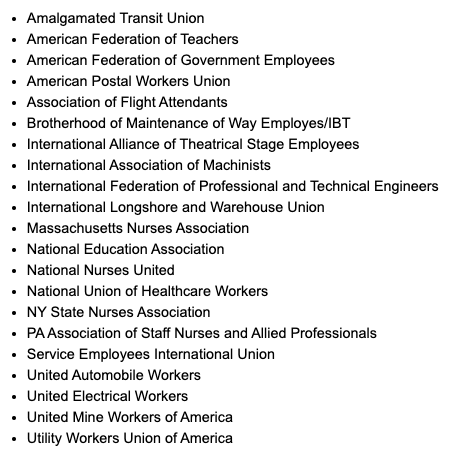
In any case, here’s some back-up quotes from the national unions, beginning with the ones opposing the Medicare for All legislation.  Obviously, this compilation will need expanding and/or amending from time to time.

IN OPPOSITION:
• Fire Fighters: nope
Schaitberger: “We cannot support the notion that our members ... should be forced to give it away in favor of a government-run program”
• AFL-CIO: nope, not yet
Trumka: “You can’t ask the American worker, who sacrificed wages and everything, to simply say: ‘Okay, I’ll accept this plan here.’”
Trumka, telling Fox News: “While single-payer health care is the way of the future, any plan for the present must allow union workers to keep the plans they fought and sacrificed for.”
• Communications Workers of America (CWA): nope, fix what we got
2018 Legislative issues:  protect and expand Medicare and Medicaid, defend the ACA

PRESUMABLY ENDORSING the House Bill, working off
LaborforSinglePayer’s list on the right.  I googled around for policy quotes, and in some cases couldn’t find anything solid.

• ATU (Transit): Yes
Convention statement Oct 2019: delegates overwhelmingly passed resolutions including “supporting the Medicare for All Act of 2019”
• AFT (Teachers): not really
Weingarten: “Medicare for All is one way to fix the problem.”
• AFGE (Gov’t Employees, incl. med’l workers at the VA): dunno
Simon: “We recognize that the enormous premiums fed employees are required to pay are far higher that when they’d pay in new taxes under M. for All. They would come out ahead, unequivocally.”
• APWU (Postal Workers):  Yes 
Union statement:  “The APWU adopted a Medicare for All resolution at the 2018 National Convention . . . The APWU is proud to stand with the Labor Campaign for Single Payer and has long supported a shift away from the private health insurance market to a government run program.” They also just endorsed him on January 30.
• AFA (Flight Attendants):  dunno
Nelson: says there is broad support in the labor movement for it; backs universal coverage; told Politico that health plans are a “huge drag” on their bargaining
• Brotherhood (BMWED-IBT, a div. of the Teamsters): Yes
Rally notice, April 2017: demands “single-payer health plan that covers all Americans”
• IATSE (Theatrical Stage):  on the list for yes, but I can’t find a statement

• IAMW (Machinists and Aerospace):  Yes 
Martinez: “A single-payer system ... is the only afforable way to guarantee quality health care for all Americans. I urge you to support ... H.R. 1384.”
• IFPTE (Engineers):  Yes 
Press release, Sept. 2017:  “Today ... formally announced its backing of the Medicare for All Act of 2017, a bill sponsored by Vermont Senator Bernie Sanders”
• ILWU (Longshore and Warehouse):   Yes 
Website post, Feb 2017: “The ILWU has been advocating for a national, single-payer health plan since 1938, and remains active in that effort.”
• NEA (Education):  Sort of 
Egan statement March 2019: “... we would like to express our support for the goals of the Medicare for All Act (H.R. 1384) ... We applaud your vision of a single-payer system.”
• NNU (Nurses):  Yes 
Policy statement:  “Our health care system is broken ... Medicare for All Act of 2019 ... would expand our current Medicare system to provide high-quality, comprehensive health care to everyone.”
• NUHW (Healthcare Workers):  Yes 
Press release April 2019: “... we enthusiastically welcome today’s introduction of the Medicare for All Act of 2019 by Ernie Sanders ... the most sensible solution to our nation’s broken health care system.”
• SEIU (Service): not really
LeftVoice reports in Sept 2019:  “refuses to support anything outside of status-quo liberal politics”
Frane: “We are supporting any policy proposal or legislation that moves us in the direction of universal coverage.” 
• UAW (Auto): can’t say, since I can’t find a direct statement

• UE (independent Electrical, Radio, Machine):   Yes 
76th convention resolution:  demand for Congress enacts HR 1384/S 1129
Call for action: call your Congressmen and tell them to co-sponsor HR 1384 
• UMWA (Mineworkers):  Yes 
Roberts: “Let me tell you what you need in this country — you need national, single-payer, Medicare for All.” 
• UWUA (Utility):   Yes 
Press release April 2019: “Utility Workers Applaud Introduction of Medicare for All Act of 2019:  Passage of a single-payer national health insurance model would be an important step toward leveling the playing field between rich and poor, sick and healthy and young and old.”

There are some signs of hope.
Members of the Mass. AFL-CIO passed a resolution to endorse a prez candidate only on the condition they’d support Medicare for All (the Intercept, Oct. 9, 2019).
And some unions are fighting back against a centrist Democratic claim that Medicare for All would “undo the hard-won collective bargaining gains of unions.” (Common Dreams, Aug. 2, 2019).


October 8, 2019

Warren-wobble

Jordan Chariton has just posted some important reflections regarding Elizabeth Warren's positioning on "single-payer."  Not that her backpedaling hasn't been pointed out years ago, because it has (examples: here and here).

His point is that the "problem with Elizabeth Warren isn't that she doesn't on paper have good plans now. The problem is we don't know if she's actually going to fight for the things she is proposing now."

In the video he's mounted on Status Coup, there's some text and bits of Jim Braude's earlier interview on Broadside showing where the senator advocated specifically for single-payer in 2008 — see the first 5 lines of her campaign's Feb. 6th post in Facebook in the screenshot below. Four years later, he says, Warren ran against that position (video clip beginning 01:02).

At 02:58, Braude asks Warren directly for her "philosophy": Would single-payer be her position?  She dodges that entirely with "I think you gotta stay with what's possible ... we need to consolidate our gains around what we've got." Even when he presses her with text of her own 2008 words, she offfers more of the same: "We've got to keep moving in the direction of getting more families covered [etc.]"

As fervently as Warren once advocated single-payer, she equally or even more fervently in 2012 fought to hold onto the Affordable Care Act:  we should "stay with what's possible."

Chariton is totally correct:  Warren changes her position and changes her conviction, which contributes to "a slow, gradual death of incrementalism."

Her words always sound rational, but she squirms with political expediency just like the rest of them*
                *Bernie excluded

and Progressives are tired of the backstepping, the centrism, and the half measures that bring no relief from the relentless corporatism, personal financial burdens, and discriminatory choices built into the current for-profit system. It doesn't, won't and can't work for all until the underlying structure is torn down and rebuilt.

October 5, 2019

"Lobbying on Medicare for All Skyrockets"

That's the lead article in the current issue of Public Citizen claims. It seems to be a print version of Craig Sandler's report "Fever Pitch: Surge in opposition lobbying and advocacy validates the credibility of the Medicare for All movement," summarized and made available for download late last June.

The growing support for "single-payer" health care brings both good and bad news.

Good, because people are starting to pressure lawmakers into doing something about the for-profit, mostly superfluous structures of insurance companies and the downright greed of their upper management.
And bad, because ...
Major opponents, including Big Pharma and for-profit insurers, now view Medicare for All as a legitimate threat.
Running these middlemen out of town is bound to be a generational uphill slog.

According to the Sandler report, the total number of lobbyists working on Medicare for All in Washington, both for and against it, went up almost ten-fold from 2018 to 2019. Of the 270 lobbyists counted earlier this year, an overwhelming number were "hardline opponents" of single-payer.

Big Pharma, hospitals and insurance companies pouring money into attacking what amounts to a huge new social program is bad enough, but the way they do it is even worse — through fear-mongering and disinformation campaigns. They publish misleading articles, op-eds and books, megaphone bogus research, avoid peer view, and get endorsements from elected officials and other well-known people who, honestly, don't do deep dives into this stuff on their own.

The details are difficult, and they're not fully worked out. That's been the case with any humongous social program a country tries to install. For example, we entered the 1930s as the only modern industrialized country in the world without a national system of social security. The first version of the Social Security Act became law in 1935. Amendments were added in 1938, 1944, 1946, 1950, and 1954 before they got around to adding Medicare and Medicaid into it in the 1965 version (as Titles 18 and 19).

And then it took many decades to build Medicare into the comprehensive social program it is today.  In 1965, it didn't have physical, speech or occupational therapy, chiropractics, or hospice. Part D was proposed in 1999, enacted in 2003, and went into effect in 2006. It still doesn't have long-term care, hearing aids, crowns, eyeglasses, and yes, incontinence pads — all items seniors need. They're part of the life cycle, and I can't wait til Part E, F, G, H, and I get built to make these cheaper.

Not easy establishing a large social system, and always generational.

This country can do it, we've done it before. But this time round we've got to fight extra hard because the system is awash in corporations-are-people kinds of influence and corrupt governments.

Particularly this one.


Lewis Black on Canadian health care — a rant
and a hoot

In his own inimitable way, Lewis Black reads a comment he got from a Canadian receiving a fair chunk of Canadian health care from a Canadian hospital bed.

Start from the beginning, or skip to 00:24, where the guy says:  "I'm so tired of hearing capitalist clowns in the U.S. talk shit about our health system," and proceeds to explain how it works there in real time. 

It's so worth the three minutes it takes to view this clip. So grateful to Mr. Black for posting it, and I'm guessing he wouldn't mind me telling people about it.


October 1, 2019

Tightening up the message — finally!


It's been infuriating watching Bernie and the progressive Dems who back his Medicare for All "single-payer" bill explain it to the voting public.


Bernie's my guy, I'm not changing that. His track record is enormous.

But, here's the kind of thing that goes on.


In the CNN debates Bernie got asked the question: "Will taxes go up for the middle class?" (at 00:14). His answer: "You're quite right. We have a new vision for America," and then the usual litany of numbers and statistics, all of which we've heard for half a decade and none of which work for people who want hard answers.

In this video of Bernie stumping in Iowa a week ago, he starts the subject of healthcare at 10:23 with that normal stream of statistics, then poses the rhetorical question at 10:43:  "Why do we spend so much on healthcare?"

What follows is a slew of more large numbers, a couple of repeats of the question, some audience interaction, a false start at 11:31 to try to answer the question, and an additional run of large numbers on spending, lobbying, profits, the high cost of insulin, drug companies overcharging, price-fixing, a corrupt industry, which as president he says he intends to address.

Now we're at 12:50, and he poses another rhetorical question: "Is healthcare a human right?" Which leads to more fluffy stuff about what other countries have and what false friends the insurance companies are. Muddying the issue still further at 14:38, he compares his new bill to Medicare — yes, the government program seniors have now — saying he wants to make that better, that he'd phase it in to cover everyone in the country over the next four years.

This is not the way to SELL Medicare for All. It isn't even the way to EXPLAIN Medicare for All, since everyone knows that the health insurance seniors have now includes all kinds of supplemental insurance and drugs provided by the very entities his Medicare for All bill is aiming to get rid of: for-profit insurance.

What a mess. NPR cites a KFF Tracking poll that shows how confused people really are:
Polling has shown that many Americans don't understand that private insurance would largely disappear under "Medicare for All."
You simply can't answer the question: "Will it raise taxes" with a simple "Yes." People stop listening once you say that.

The best answer on the campaign trail is a sledgehammer of an argument, like the way Kyle Kulinski put it in today's video post of Secular Talk: "It's actually a tax cut."

Kulinsky attributes that to Nina Turner, who was apparently on the road in Iowa this past weekend campaigning for Bernie. He says, and I'm paraphrasing here:
If you get rid of the private "taxes" (i.e., what you pay to the insurance companies) and they're more expensive, and you raise the public taxes, there's a net savings. That's an effective tax cut.

Bernie's learning.

On Stephen Colbert a few days ago, he did a good job. Healthcare starts at 05:58 or so, and at 06:35 Colbert asks: "Is there an increase in taxes on the middle class to pay for Medicare for All, or rather, where would the tax burden go to pay for that?"

His answer this time so much better:
Under my legislation ... nobody in America will pay any more premiums. [fluff]  No more copayments — gone. No more out-of-pocket expenses — gone. Nobody will go bankrupt [fluff] — all of that is gone. Nobody in America under my bill will pay more than $200 a year in total for their prescription drugs, and we'll stop the ripping off of the American people by the pharmaceutical industry. Now, having said that, is healthcare free?  No, it is not.  So what we do is exempt the first $29,000 of a person's income — you make less than $29,000 you pay nothing in taxes — above that, in a progressive way, with the wealthiest people in this country paying the largest percentage, people do pay more in taxes. But, if I say to you that right now you're paying $20,000 a year in a tax called a "premium" for the insurance companies, that's gone, and I say Stephen, you're paying $10,000 a year now to the federal government, you're $10,000 to the good, you'd ask me "Where do I sign up for that." 
Yes, where do we sign up for that!

I'd love to see a lot more of this approach, and far less of the damn billions and billions and top 1% we've been getting from him for half a decade.


April 23, 2012

Socrates' man at City Hall

The good thing about retirement is that I have the time and energy to read.

The bad thing is that some of the stuff I read reminds me of Michael Bloomberg's failed education policies and the mess he's making with NYC public schools.

This afternoon I was two-thirds the way through I.F. Stone's Trial of Socrates when the quality of his governance came to mind.

I recall how frustrated I was studying Plato's Socrates way back in college because of what Stone calls the "semantic fog" of his negative dialectic. Socrates affirmed nothing himself, says the Roman writer Varro, who lived a few centuries later. He refuted everything anyone else had to say. It was purgatory for me that semester trying to work out the thread of the Socratic dialogues.

I guess in the murk of it all, I never quite registered how deeply Socrates despised democracy. According to Stone, he "saw the human community as a herd that had to be ruled by a king or kings, as sheep by a shepherd." I don't know how I came away with the idea that the man was a founding father of Greek democracy, because clearly he wasn't. He didn't believe that the demos, the average Joes, could be trusted with decisions of state. Rather, he favored autocracy: it was the autocrats who knew best how to rule. That kind of thinking would have made him very popular with the Bloomberg crowd.

But, on one occasion Socrates did publicly criticize an autocrat and his supporters. It was just after the Peloponnesian War in 404 B.C., when Critias and the newly empowered Thirty Tyrants went about executing and exiling hundreds of upstanding pro-democratic Athenians.

Ordered to help round up one such citizen for execution, Socrates refused. His reasoning was explained by Xenophon like this: 
"When the Thirty were putting to death many citizens of the highest respectability and were encouragining many in crime," Xenophon writes, Socrates turned a favorite analogy against the Thirty. "It seems strange enough to me," Socrates said, "that a herdsman who lets his cattle decrease and go to the bad should not admit that he is a poor cowherd; but stranger still that a statesman when he causes the citizens to decrease and go to the bad, should feel no shame or think himself a poor statesman." (Stone, p. 158)

Michael Bloomberg is such a statesman.

For when he starves schools of resources and allows them to "go to the bad" to achieve a political agenda of a whole other order, he is shameless indeed.

The April 19th protest at Tweed against the most recent projected school closings probably made as little difference to Bloomberg, Walcott, and their PEP collaborators as rallies have done in the past.

But the words in a press release for the event speak truth to power, and the stain this mayor leaves on public education cannot be removed.


PRESS RELEASE
extracted from a post in Ednotes
With a cynical misrepresentation of the truth, Mayor Bloomberg is holding 26 Persistently Lowest Achieving (PLA) schools hostage to his demands ... The NYCDOE refuses to return to the negotiating table and has threatened 26 of the 33 (PLA) schools with closure through a process called "turnaround".

"Turnaround" is a failed policy because it is disruptive and distracting to the entire school community. It is a model that has been borrowed from the business world and we all know how well the American business model has fared during the past decade. Turnaround destroys bonds between students and teachers. It demoralizes the entire school community when instead the school community should be bolstered and strengthened.

All of the PLA schools have endured years of neglect and threats from the NYCDOE. We have worked hard to move our schools forward and we are making great strides in overcoming the tremendous obstacles that were put in our path by the NYCDOE. Why is Mayor Bloomberg still threatening our school communities?

Bloomberg's policy of school closure has gone on too long.  In three terms of Mayoral Control, Bloomberg has now closed over 100 schools.  Many of the schools voted to phase out on February 9th, were schools opened under the Bloomberg administration. The policy of closure, phase-out, and now turnaround, has not improved our school system in any way.  Bloomberg continues this policy only to hide the data that would paint him as a failure on education.  He is ruining the lives of a generation of students all for his own political gain.

As recent research has demonstrated, having a consistent set of teachers increases student success. However, a huge turnover in staff will have a negative impact on the students who remain at the affected schools, decreasing the likelihood of students' graduation and achievement.  Furthermore many of the programs that are successful at these schools, including electives, clubs, and AP courses, many not run when the majority of the new staff is untrained.

Mayoral control of the NYCDOE under Mayor Bloomberg has been a colossal failure. The very idea that one person has been granted the authority to close any school without input from teachers, parents, and students is a mockery of the concept of democracy. What lesson are our students learning about how this city and our nation work if the voices of affected communities are shut out? We need an end to mayoral control of our public schools.

February 18, 2012

"An almost total capitulation by the union"
— Jeff Kaufman


You can read Jeff's whole analysis of the new (d) evaluation system on the ICE blog, which he ends with a very dark prediction:
If today's agreement becomes our actual teacher evaluation system, then there will more than likely be massive teacher firings beginning in 2014.

Some of the comments are worth a chuckle. There's a lass called Sandra who thinks getting tenure in the old days was a "gift":

I don't feel one bit of pity to those teachers who were gifted tenure back in those days of desperation and think that that should save them from a true evaluation of their effectiveness ...
I'll be damned if I know what she means by "those days of desperation." I'm assuming Sandra was a youngster when the rest of us were chewing our fingernails over the Board of Ed's certification tests. The music exam was distinctly uncomfortable, even with a Masters and heading into a doctorate. You couldn't just swim in on Music Appreciation and your instrument. There were also tests on piano performance and sight-reading, and the whole thing only came around every few years. Tough titties if you failed it, because no one was going to give you NYC certification or tenure without it.

Ah, those were the days, when deep knowledge of a subject was actually valued. Now your career's a toin coss: heads if your administrator recognizes and respects variations in style, personality and methodology and makes use of your talents, tails if your evaluation is scripted by an inexperienced Tweedle or a politically appointed senior administrator.


I have to credit Wiki for using the Michelangelo painting as an antecedent of our "Perp walk."

Neat.

November 4, 2011

Going gently into that good night:
Huh???

Retirement.
Different from what I thought.
For those whose adjustment has not gone as smoothly as they had wished, here are some notes I took from Jules Willing's book The Reality of Retirement.

It was this or psychoanalysis.


[Some notes, some paraphrased, some in direct quotes. And I didn't take notes on the chapters dealing with married life.]


Ninety percent of retirees (he's only talking about people retiring from professional jobs) have a health crisis the first year.
Retirement means the total loss of authority.
People try to deal with "safe" problems, i.e., those whose outcomes do not really matter. These safe problems disguise the cause of the anxiety. 
We get depressed because we're facing the question whether we were essential in the first place. We have to deal with the fact that what we thought of as our "good works" will be forgotten. We are thus psychologically swirling, and to a large extent unaware. If we are aware of some of it, there's little we believe we can do about it.


Retirement transforms a world where there was an active present, a meaningful past and a pregnant future into a world where there is no present and no future.

At retirement, all of these reactions happen at the same time:
— Recapitulation of a career
— Final judgments on that career
— Subtle devaluing of that career.

Simultaneously, there's the giving up of career goals never attained. Everyone underestimates the trauma of giving up unattained goals. A person facing retirement can scarcely do so except by diminishing their importance.
Upon entering retirement, you're at the very lowest point at which you’re capable of planning a future. You can’t visualize it, the data is too scanty. And you’re feeling loss, self-doubt, and psychic diminishment. Rational and analytical skills are unsuitable for introspective thinking.

The retiree has to invent his own concept of himself. He starts at a familiar point (e.g., golf, etc.), but plans don’t work and he's taken aback. He mistakes fantasy for reality.

He starts to make a big action plan for the future, but it's the worst possible time to create such a plan, because one's ability to think things out efficiently is severely limited at this juncture. We've become a deactivated mechanism, with zero readings for productivity and potential for further achievement, career progress, influence, authority and responsibility.

The entire value system is overthrown. We discard vital parts of our identities—most particularly the parts that have value to ourselves. To accept the fact we’re forever useless is psychologically in a class with suicide and self-mutilation, except these feelings are entirely interior experiences, unobserved by others.

We try to repress and conceal our emotional distress because we consider it be an inappropriate response, a fault or failing in ourselves.


The tools people carved out successful careers with had been judgmental skills, a capacity to be right more of then than wrong, first-hand knowledge of the terrain, memory, history, carefully built network of relationships, a structure of enormous complexity that must be constantly tended, skill of finding optimum line between one’s own career goals and the objectives of the organization. These must all be discarded at retirement.

Very few of us, no matter how long we have lived, know ourselves well enough to be certain that we have any worth aside from what we know and what we do. The idea of abandoning the career skills seems inevitably linked to the idea of self-diminishment. We have no foundation for imagining ourselves to be able to exist as a whole and functioning person outside the social and psychological world in which we made a career.

We ask ourselves: What parts of ourselves can we save and enlarge to fill up the empty spaces? What skills can be adapted to other purposes? What knowledge or experience can be reshaped and redirected? Whatever we can’t use or redirect will be junked.

There's thus a strong tendency to fill the void with almost any sort of goal, however arbitrary or poorly thought, the idea being not so much to achieve it as, by establishing it, to give one an air of purpose and direction. This finds its expression in busy-ness, preoccupation with plans and arrangements, investigation of all sorts of technical questions, and pinning down of details. The impression is of someone accelerating rather than slowing.

Busy-ness seems to be the universal remedy for easing the shock of plunging into the unknown.  When the initial plans don’t work, we tend to describe any plan as “getting it out of my system.” What we really get out of our systems is the myth of retirement as a perpetual holiday.

Retirement as an experience separate from aging is seen only peripherally and sometimes not at all. The dismantling of the social structure (i.e., the workplace) of the career life is far greater than one anticipates.
We are often unaware that we have been on a steady diet of small satisfactions, and we don’t know we’re addicted until the supply stops. 
Retirement does not assure a flow of accomplishment and satisfactions: they can't be provided in the early stages. There's no continuous level of activity that throws off these small sparks of satisfaction. It’s a period of stops and starts, of isolated and one-time problems. No day is ordinary, nothing is routine.
There is no larger structure into which we must fit. Nothing really has to be done now if we want to do it later, and practically no one is affected by whether or not it is done at all. Pressure must be almost entirely self-generated rather than imposed by others or outside events. Thus, we  become aware that some vital fluid has stopped flowing.

It is almost as if we sense that the struggle is essential to survival—and that there must be something to struggle against. The capacity to struggle must be fueled by inner forces when outer forces no longer provoke the adrenaline flow. We are addicts who must get our kick one way or another. The alternative is too awful to contemplate.

What we are struggling against is not placidity, but paralysis, the leveling down to a monotone, the loss of sharp reflex. Our great dread is that the jiggling marker will subside until it draws a straight line, like an electrocardiograph of a lifeless thing.

 
We feel disoriented and helpless at having to find an answer to the question of what we want to become. Throwback to childhood: What do you want to be when you grow up?

Activity is the operative word at this stage. When work no longer provides it, interests and hobbies are substituted. Early in retirement there’s an unnatural carryover of attitudes: you approach your hobby as you did your work: intensively. Hobby gets the highest priority, the most time, the greatest energy, the extensive investment. At this stage it’s job replacement, not a “leisure activity.”

One part of the universal dream is “the trip.” A trip performs other functions not as clear as a reward, the ultimate vacation. It is a reassurance, a validation of the fact that all is well, that one’s affairs are in order, that one can depart free of care and worry and put anxieties to rest. Corroboration that one is physically fit and active. Verifies you can afford some luxury. It is a safe first step into the unknown new way of life – you go to a place never visited, enjoy it, and return safely. A metaphor of reassurance that one can enter retirement and survive, even enjoy.

Two big differences between other vacations and this one: from this one you don’t come back and pick up where you left off, and retirement is not for an interval, it is for as long as you live. Retirement does not feel like a proper stopping place but more like a permanent interruption.

The retiree has met very few people who complete this process in less than a year or two; settling into new roles takes that long. These years are transition and time for discovery. You become aware of problems not anticipated and feelings never experienced. In a state of self-awareness, busy sorting out what is good from what is not, matching actual experience with prior expectation. You watch yourself critically, somewhat mistrustfully.
How many of the things one “never had time for” remain undone or forever uncompleted in retirement. Part of the revelation is that many of our yearnings are for things we really didn’t want, that we have been nourishing ourselves on spurious notions of what we are capable of — we learn we’ve created our own myths. We may sign up for a course or two, then go onto other things, fool around with a few chess books then lose interest, begin great and little adventures we set store in but find them without nourishment. Part of the adjustment in the early stages is this sampling and discarding of long-held ambitions.

Retirement brings an end to striving. One no longer has to measure up, to achieve, to produce, to deserve whatever is received, to protect and defend whatever one has won.

No one is keeping score anymore; the game is over.

It seems logical that a new game should begin, but this trail of logic will never get to the question “What am I now free for?” this is a question that looks to the future, unlike it’s counterpart, “What am I free from?” which looks at the past. An entirely different equation thus: retirement = freedom = release of formerly employed energy = action in new directions.
While making the abrupt turn into retirement, we have slowed down for the curve and the road ahead has not yet fully come into view. This is the point at which so many of us go off at a tangent and miss the right road altogether. What successfully retired people take most pleasure in is themselves — who they are and what they are becoming.

The act of relinquishing all at once your unattained career goals is an act of profound meaning and cries out for recognition. Without a ceremony of closing and renunciation, retirees have no way to mourn the causes that now become forever unfinished business, to honor the intentions that will never be fulfilled. To turn away from them so casually is to trivialize them and diminish themselves.

For one's children, “home” was the place where parents remained and children departed.
Retired parents don’t know the extent to which the place where the family had lived, or the familiar place where they as parents were, becomes for the children a fixed point, firm ground in a shifting world. It was a place from which they measured psychological distance; it was what they were growing away from, achieving independence of. So, if the retiree changes his home for somewhere new, he has to examine what effect that has on the kids.

Payment. The assumption is the retiree should be happy to do for nothing what he used to be paid to do. What is most resented is being denied the option of foregoing payment. Feeling of being written out of the economy. I must pay for everything, but no one expects to pay me for anything.
The distinction generally made was that retirees approved donating time and energy to causes outside commercial considerations, though these did not use their best skills. They balked at being used by those with self-interest: e.g. a hospital that saw them as a ready pool of free labor and also at using retired volunteers in ways that deprived working people of jobs.

It may come down to this: that in our culture, value is measured in dollars and expressed in price, so the retiree gets the message that his services have no real value. He’s expected to be glad of the opportunity to get the reward of satisfaction instead of money, because the remaining alternative is the veiled threat of not being permitted to participate at all.


We have become a new form of leisure class — a leisure class of moderate means. We have long know the idle rich and the idle poor; what is new is the idle middle class.

Primary characteristics of retirees: they have incomes for which they do not work. They have 10-20 more years of productive life, but no clearly formulated sense of the purpose of these years. They are a generation whose only established relation to the rest of society is to constitute a market for what others produce.

We need more than this to justify our existence. We must consciously try to invent a future, find purposes and goals appropriate to this stage of life and to make it separate and distinct from aging.

Self-evident solution: The person set to retire should develop outside interests and activities, but they must be designed to approximate and embrace similar kinds of tension, high level of difficulty, possibility of failure, etc. that (business) professionals became addicted to, that kick off the conditioned responses in us that keep us feeling alive and worthwhile. These suggest a good general direction: the task must provide a genuine sense of achievement, it is a real-life task, it enables using our authority, and it involves some risk (which gives it the bitter tang of reality that takes it out of the class of things we think of as hobbies and interests).

Most of the books on retirement advocated advance planning.
The remedy would be to find a way to retire gradually or partially.
Negotiate something with your employer.

We should recognize the wisdom of investing both time and money in preparing ourselves for retirement, yet we tend to feel impoverished if we do anything that lessens our income or our capital, and wasteful if we spend any substantial amount of time in getting ready to retire.

Common thread amongst retirees: Calmness. They are invariably active — not in the level of busy-ness, but in the connection, the maintenance of linkage between the self and other selves. Diversity: mix with other generations and other kinds of people.

Personal values will change. The middle class values power over others and our own lives and possessions; acquisition of material comforts and conveniences, wardrobe, kitchen, nice home, car; progress in such forms as upward mobility, promotion; security of social and professional recognition and steadily growing financial reserves. 
In retirement we don't much change them. Security does not increase, the upper limits of upward mobility have already been reached, power does not grow, the time for acquiring turns into a time for disposing of things no longer necessary. We don’t strive for promotions, raises. We will not get much richer or better known. We don’t really need the big house and the things in it. We are no longer in charge of anything except ourselves.

We feel we have finished with all the important things and what remains seems comparatively trivial, not enough to devote our lives to. We need a new list of important things, and the only place we can look for new values is among those what weren’t very high on our first list. And that means making fundamental changes in our reasons for living.

There must be developed a focus in one’s life other than the all-consuming intense focus of successfully earning a living.

Part of the act of retiring is the act of altering, perhaps reversing, the values we have been living by, a slow and difficult process that must begin long before we put our value system to the test of retirement.

________________________________________________
I also looked at Tillie Olsen's Silences. She quotes Rebecca Davis:
"Drift with the stream because you cannot live deep enough to find the bottom."

August 25, 2011

Teaching math: That is the question


The following was circulated in the listservs, and I'd like to post it here as well:


Some Observations on Structural and Social Issues in K-12 Mathematics Education

by Arjun Janah


(A) The problem does not lie mainly with the current organization of the mathematics syllabus, but rather with structural & social issues such as:

(1) the pace at which these topics are taught, which leave little room (at least here in New York city) for confidence-building practice and for the kind of applications the authors of this article mention;

(2) the misguided attempt, noble in intention but cruel and disastrous in practice (for both students and their teachers) to try to teach all students at the same pace and to the same level of rigor, whether they are willing, prepared, able or not;

(3) the social problems arising from the cultures that permeate our communities, arising either \"naturally\" from historical and socio-economic causes, or \"artificially\" from the manipulation of youth by the media and its commercial support;

(These social pathologies, intruding into classrooms and homes, destroy focus and make the struggle that is learning impossible to carry on effectively.)

(4) undue obsession with educational methodology, its over-generalization and the imposition of methodological fads and diktats on teachers;

(5) once due, but now, belatedly (greatly exaggerated, undue and injurious) attention to results on standardized examinations.


(B) There is a reason for the abstraction that we find in mathematics. It gives it a generality and concision that is lost when we particularize it.
That said, time and energy are needed to see how the abstractions arise from the particular and concrete and can, in turn, be applied towards solving particular, concrete problems — including those of everyday life. And extended journeys into formal abstraction are best avoided with younger students, especially those in lower grades (typically below the tenth) — and with those who are unable, for a number of reasons, to comprehend these.

(C) As in other K-12 subjects, due attention needs to be restored to traditional educational subject-matter concerns. These include: purpose, choice, motivation, sequence, focus, pace (and time allocation), practice (and habituation), along with, of course, application.
Students need all of these, plus time and effort, to build familiarity and confidence and to deepen and broaden understanding.

(D) There are no substitutes for logical coherence, sequence and structure on the part of the syllabus or for focus and effort on the part of students and their teachers. Given these, the small successes and the understanding and enjoyment follow. And it is these that sustain the focus and effort, in a virtuous circle.

August 17, 2011

Going backwards in America

Thanks to Big Money in the hands of the wrong people.
Oops, my bad. Big Money is ALWAYS in the hands of the wrong people.


Produced by KochBrothersExposed.com.